
LPA Introduces New CRE Certification Program
You’re familiar with MAI, SRPA, AI-GRS, and USPAP. But, this holiday season, LPA is excited to announce that each and every one of its Team members has earned one of the most coveted designations in the world, let alone the commercial real estate industry.
“Nice.”

Don’t get us wrong; we certainly don’t mean to downplay the importance of Appraisal Institute certifications and standards. Even without a triple-dog-dare, we adhere to our profession’s best practices like a tongue to a frozen flag pole. But the Nice Certification, issued by the jolly old authorities at the North Pole, adds a bit of shine (you could even say a glow) to our credentials.
Naturally, you would expect a commercial real estate valuation professional to produce accurate, principled, and timely appraisal reports. However, this new certification recognizes the greater level of service we strive to provide. We believe our insistence on integrity and transparency, our commitment to teamwork, and our embrace of innovation instills confidence in our products and brings peace of mind to our clients. And St. (emphasis on “Saint”)Nick seems to agree! It’s these unquantifiable qualities of niceness that helped us earn this Major Award.
We should also mention that not every organization can claim to be Nice. Sadly, some in our field are downright Naughty. They seem to view deadlines as mere suggestions. They rarely respond when you jingle their bells. And their reports can get as sloppy as a snowman on a warm day. (Why do they ignore the details? We don’t know at all. Perhaps their hearts are two sizes too small.)
Luckily, you don’t have to settle for the lumps of coal the not-Nice try and pass off as diamonds in the rough. If you’ve been frustrated by less-than-nice service, it may be time to give us a call. Each one of our eight offices welcomes carolers!
It would not be in the spirit of this giving season to keep this precious and prestigious honor to ourselves. That’s why we’re not only inviting our clients and partners to apply for your very own Nice Certification — we’re also streamlining the application process. You, your co-workers, friends, anyone who makes your work and life a little better: all are eligible!
Visit https://www.niceornot.lpa.com/ to customize an award with your name and acts of kindness, then be sure to display your Certificate in a prominent spot. Location being everything in real estate, we recommend one certain not to escape Santa’s notice: on the mantel, next to where you’ve hung your stockings with care, or right by the milk and cookies.
Thank you for trusting us with your business and making 2021 a very good year indeed. Merry Christmas and Happy Holidays from all of us here at LPA!
Strong demand has pushed rent growth in the multifamily market to highs not seen since before the Great Recession. COVID-19 plays a significant role in this story, and much analysis has focused on the virus’s impact.
However, several factors driving the demand for apartments, condominiums, townhomes, etc., have been building momentum since before the pandemic. According to Jim Newell, MAI, Director of LPA’s Institutional Advisory Group, “urban multifamily growth was stifled in 2020 and has mostly made up for lost time in 2021.”
How high might multifamily property values rise in 2022? More importantly, is this appreciation sustainable? At face value, changes in tenant demographics and the rationality (or irrationality) of the market may seem to offer sufficient explanation for multifamily’s current performance. But understanding which factors are foundational requires deeper analysis.
Keep reading for Jim’s unique insights on what’s happening with multifamily right now — and what that might mean for its future.
1) Americans keep moving to the Sunbelt.
The pandemic unquestionably accelerated migration to the American Southwest. But the most recent decennial census has quantified just how much this trend predates the wave of relocation that began in March 2020. More importantly, what else do we know about these new Texans, New Mexicans, Arizonans, etc.? Who are they, where are they leaving behind, and what are they hoping to find in their new home states?
Baby boomers are among the largest group of migrating Americans. The Sunbelt’s lower cost of living and mild winters promise a more comfortable retirement — a phase of life many boomers have entered during the Great Resignation. Meanwhile, a strong stock market has fattened 401ks and IRAs enough to make early retirement a more viable option.
But seniors aren’t the only ones on the move. Corporations are relocating their operations, and often their headquarters, away from the high cost-of-living, stringent regulations, and tax burdens of coastal urban centers. Plus, they’re finding more business-friendly environments in cities such as Dallas, Austin, and Phoenix. Meanwhile, expanded opportunities to work remotely have prompted many employees to consider quality of life measures over proximity to the office when deciding where to live.
There’s further evidence that investors should look south and west. Demand in these regions and robust transaction volume have driven up property values, attracting investors despite the economic uncertainties of the past year and a half. Dallas, Houston, Atlanta, Miami, and Phoenix now lead the country in multifamily development, delivering more than 44,000 units in 2021. Moreover, nearly 171,000 units are currently under construction in these Sunbelt cities.
Jim adds an important qualitative measurement to these numbers: the weather. Specifically, that extreme summer temperatures have not deterred migration to the Sunbelt. “In 2021,” he says, “markets such as Phoenix defied seasonal trends of years past and experienced tremendous leasing velocity and rent growth.”
2) Single-family home prices are reshaping the American Dream.
Boomers may be on the move, but more and more millennials are nesting. Numbering more than 72 million, these individuals born between 1980 and 1995 make up the largest segment of the U.S. population.
While the majority of millennials — especially millennial parents — identify homeownership as one of their personal goals, the low supply of available houses has radically altered their timetables. According to a 2019 Apartment List survey, the number of millennials that say they prefer to rent was ticking up before the pandemic caused domestic real estate to begin overheating.
“The major push of institutional investors into the single-family rental market has likely contributed to higher home prices,” Jim adds. In fact, more and more new housing starts are build-to-rent units. As the Associated Press recently reported, “[i]n the third quarter [of 2021], builders broke ground on 16,000 single-family homes slated to become rentals. That’s the highest quarterly total of housing starts for built-to-rent homes going back to at least 1990.”
“Trends like these have made it even more difficult for first-time homebuyers to make the jump,” Jim explains. “Growth within the multifamily rental market has been very strong as well, with many young families choosing this route.”
That said, the rising cost of homes isn’t the only factor keeping millennials in their apartments. Stagnant wages and heavy student loan debt have made it harder for them to save up for a down payment or qualify for a mortgage with friendly terms. The current administration in Washington has pledged to address the issue of student loan debt, and some steps have been taken to fix the unwieldy loan forgiveness program.
Even a partial debt-cancellation via executive order or a lowering of interest rates on government loans could free up cash for millennial families saving for a down payment. However, Jim notes that, for now, “the market is likely to continue obeying the rules of supply and demand rather than government policy.”
2) Multifamily cap rates are experiencing dramatic compression.
The trend toward compressed cap rates in the multifamily market is showing in most regions of the U.S. This compression is a sign that both investor confidence and pent-up demand are driving up prices. Suburban multifamily is leading the way, particularly Class B workforce housing.
“The occupancy rate growth we’ve seen in suburban garden-style developments since March 2020 has largely been due to people fleeing urban centers over density fears,” Jim explains. “This was very noticeable in Los Angeles and the California Bay Area — residents relocating from San Francisco to Pleasanton, Walnut Creek, etc. This also occurred in the Seattle area, as people no longer needed to report to offices in the city and preferred the lower rents and larger spaces available in more suburban markets.”
However, urban multifamily property values are also beginning to rise. From Jim’s perspective, this rebound reflects the confluence of several forces. Data from multiple sources indicates that people are moving back to the large metros supposed hollowed out by pandemic migrants. In fact, a recent report issued by the Office of the New York City Comptroller reveals that “[s]ince July 2021, the city has registered an estimated net gain of 6,332 permanent movers, as compared to the same months in 2019, indicating a gradual return to New York City. Nearly 62 percent of the net gain over these three months occurred during August.” This same report also notes that wealthier, Manhattan-based renters were more likely to have moved out of their Class A properties than their less affluent neighbors — regardless of the density of the neighborhood they left behind.
Investors are following these returning tenants and new arrivals. “I would argue that the pricing compression we’re seeing in multifamily is due to fierce competition for lower-risk assets. There just aren’t many low-risk CRE investment alternatives to multifamily,” Jim says. “There is virtually no transaction activity in large retail assets. Office within certain markets is still good (e.g., Amazon buildings in Seattle and Bellevue), but, overall, occupancy is lagging and is predicted to continue lagging into 2022. So there are incredibly high capital inflows into new and existing funds to acquire multifamily properties, especially with debt as cheap as it currently is.” Indeed; the Mortgage Bankers Association (MBA) anticipates that 2021 will generate an all-time record high of $409 billion in multifamily lending.
Although compressed cap rates have excited the market, this trend could moderate in response to other economic developments. Class A and Class B multifamily continue to benefit from inflation as high construction costs make affordable housing starts a less profitable proposition. The scarcity of affordable single-family homes is pushing would-be homeowners into rentals. As the pandemic-caused disruptions smooth out, the housing market should cool down, encouraging more tenants may pursue homeownership.
Moreover, as the world witnessed at the end of November, any unexpected surge in COVID infections or the appearance of new, vaccine-resistant virus strains will likely spark turmoil in stock markets both here and abroad. And that turmoil will eventually have a ripple effect on CRE. “Due to allocation requirements among large institutional funds, the primary risk in multifamily would be if equities markets were to sustain a major impact,” Jim points out. “That might force rebalancing efforts that lead to liquidation of CRE assets. But, right now, fund managers are chasing yield by focusing on a handful of property types: industrial, health sciences, self-storage, and multifamily (including single-family for rent).”
4) Builders and landlords are bullish on multifamily.
In March 2020, as the stock market plunged and unemployment soared, investors took a wait-and-see stance. “Many deals in progress were delayed or abandoned entirely,” Jim adds. “Some investors even abandoned large non-refundable earnest money deposits early on.” Government rent assistance and stimulus checks stabilized conditions for most tenants, and rent payments, which lagged in April 2020, returned to near pre-pandemic levels by the end of the year, according to the NMHC Rent Payment Tracker.
After these initial hiccups, some of the largest apartment management companies moved forward with noteworthy mergers and acquisitions, demonstrating confidence that healthy pre-pandemic growth would resume. Strong demand continued through the first two quarters of this year, driving rent growth and increased sales volume.
But construction delays continue to plague the market. Steel and lumber remain stuck on container ships offshore, forcing builders to source alternate materials or halt construction altogether. According to the results of a June 2021 survey conducted by NMHC, 93 percent of multifamily construction firms reported delays caused by permitting backlogs and shortages of labor and materials.
Even with these delays making markets that were already tight that much tighter, U.S. Department of Commerce data shows multifamily starts increased by more than 20 percent in August 2021. At the same time, single-family starts decreased. Nevertheless, supply chain and labor issues will continue to impact this sector.
In summary, the multifamily market is returning to pre-pandemic norms even as it evolves to accommodate new consumer behaviors and living situations. For example, fears that the end of the eviction moratorium would lead to a sharp drop in occupancy numbers haven’t panned out. Rent payments through November 2021 are near (if still slightly below) 2019 levels. Adds Jim: “I believe many overbuilt markets are taking advantage of current market dynamics to catch up on occupancy. This will probably remain the case while supply chain and labor issues continue to impact the construction industry. The single-family for-rent sector will compete for tenants on some level. But, as long as homeownership remains out of reach for many and more and more Americans are attracted to the more flexible lifestyles associated with renting, demand for multifamily projects should remain high.”
In the early weeks of the pandemic, large segments of the economy shut down. We’ve discussed how this shock to the financial system affected commercial real estate in previous installments of LPA Insights, but we’ve not yet covered those financial instruments most closely associated with commercial properties: real estate investment trusts or REITs.
As COVID-related uncertainty slowed development plans or halted them altogether in 2020, REIT managers pulled back on capital expenditures. Their retreat throttled already tight cash flows. Eventually, managers regained a measure of confidence, thanks largely to the spectacular performance of REITs specializing in data centers and the infrastructure, physical as well as digital, that support online commerce.
Only now, with the phased expiration of stay-at-home mandates, have hospitality and retail REITs begun to rebound. The combination of effective, widely available vaccines and pent-up demand are driving consumers out of their homes to shop, dine, and travel. Office occupancy rates are up as well. More and more businesses are opening doors to dynamic workplaces, and more and more employees are choosing to walk through those doors.
Although a surge in Delta variant outbreaks has somewhat dampened this rally, analysts with the National Association of Real Estate Investment Trusts (Nareit) have cited strong underlying fundamentals in forecasting a robust recovery continuing through the end of 2021 and into 2022. In fact, Nareit reports that, by May 2021, aggregate REIT funds from operations (FFO) have returned to pre-pandemic levels.
Like the downturn, this recovery has been unevenly spread across all property types. But the fact remains that REITs are very popular with investors large and small right now. The proof is in this statistic (recently cited by CNBC): “The S&P U.S. REIT Index is one of the best performing parts of the stock market this year, up 27.9 percent through July 27.”
Deriving actionable business intelligence from figures such as these requires an understanding of the optimism and anxieties motivating financial decisions being made with regard to real properties. In this article, we’ll investigate the three main drivers of REIT performance and why they’re significant — even for CRE stakeholders whose portfolios don’t contain any REITs.
1) Inflation
Since April 2021, annual inflation has well exceeded the Federal Reserve’s target of 2 percent. The causes are complex and perhaps unprecedented. The government has injected nearly $4 trillion into the economy via several stimulus packages. Demand for goods has surged as consumers have resumed pre-pandemic activities, but supply chains remained snarled, creating scarcities that have driven up prices. Thus far, the Fed’s bankers have downplayed the threat of overheating. But, should that occur, they will deploy one of their most trusted offensive measures against inflation. They will raise interest rates, potentially causing stock prices to fall.
Unlike most securities, however, multifamily, retail, and office CRE are traditionally resistant to this upward pressure. Landlords have several mechanisms at their disposal to ensure that rents keep pace with rising prices, including CPI-dependent escalator clauses. The long terms of leases prevalent in retail, office, and healthcare provide an extra degree of protection.
Inflation worries also give REIT managers incentives to find unique, risk-adjusted solutions for increasing the income their tangible assets generate. Those properties stand to attract more investment and pay more generous dividends, attracting even more investment in turn. Far from creating a speculative CRE price bubble, moderate inflation can create a set of economic conditions in which appraisal values and cap rates move forward in lockstep.
Indeed, historical data shows that, even during what Brad Thomas of Forbes has termed “the eight worst years in U.S. inflationary history” (1974-1981), REITs “delivered inflation-adjusted total returns of 7.0 percent.” By contrast, the S&P 500 achieved 0.8 percent in inflation-adjusted returns over the same period.
As Nareit points out, however, that period predates the “modern REIT era.” Yet more recent data apparently validates the assertion that (in Nareit’s words), “REITs provide natural protection against inflation.” Comparing 20 years of weighted average REIT dividend growth per share to the annual inflation rate reveals that only on three occasions has the latter surpassed the former: in 2002, 2009, and 2020. In other words, it takes a world-changing event — 9/11, the Great Recession, and the pandemic — for REIT dividend growth to lag behind inflation.
2) Value
Industrial CRE is as hot now as it’s ever been. That’s been good news for those who’ve built an investment strategy around warehouses, cold storage, manufacturing complexes, transportation hubs, and data centers. But it has driven investors eager to diversify their REIT holdings (or diversify into REITs altogether) to seek value in those property types that experienced the most distress in 2020. So, where have investors been buying low, and what property types are they pinning their hopes to?
Healthcare has been a major beneficiary of the rising popularity of REITs. Again, the long-term leases signed by many individual medical practitioners have helped shelter REITs focused on these property types. Simultaneously, the increased use of telemedicine and suspension of elective surgeries prompted by the pandemic caused more cautious investors to hold back. Recognizing both the stability of these properties in general and patients’ ever-increasing preference for non-hospital care settings, value-seekers have flocked to REITs that have heavied up on medical offices, outpatient clinics, and ambulatory surgery centers.
Investors have also found value in shopping centers, especially those whose landlords have been most proactive about adjusting to consumers’ overwhelming — and still-growing — desire to order online and schedule curbside pick-up or delivery. Through Q2 2021, retail REITs are up 40 percent. Some malls have even been able to fill vacant anchor stores with e-commerce tenants who utilize the space as last-mile delivery hubs.
Residential REITs in the form of both multifamily and manufactured home communities have also enjoyed strong growth. However, the strength of these markets varies widely according to geography.
In March and April of last year, people and organizations migrated from densely populated, traditionally high-priced urban centers to suburbs, exurbs, and smaller cities. Yet preliminary 2020 Census data shows that this population shift, which has greatly benefited states like Texas and Arizona, is a trend that began picking up steam before the pandemic. This demographic shift helps explain the very tight Sunbelt housing market that’s turning potential homeowners into renters and leasers. Many REITs are acquiring or developing new multifamily properties across the region in response.
Case in point: as Kiplinger reports, the 17,000 Sunbelt apartment units managed by Bluerock Residential Growth REIT (BRG) have seen their aggregate occupancy rate rise to nearly 96 percent since this time last year. Average lease rates at Bluerock’s properties have increased by 3.5 percent in that same time. Bluerock plans to extensively renovate 4,300 apartments in its portfolio, adding value that more and more investors are hoping will lead to returns of between 20 and 25 percent.
Meanwhile, cities like New York and San Francisco are now seeing an influx of returning and new residents. Business Insider, citing a recent study conducted by UBS, notes that “temporary mover data signal the shift from cities to suburbs and exurbs has almost entirely ended.” The reason? Big employers. “The return to trend is most likely fueled by companies’ return-to-office efforts.”
3) “The most valuable buildings are the ones still standing.”
Economic recovery typically spurs new construction. However, present circumstances are quite different. Spring 2021 saw lumber prices skyrocket more than 300 percent. That inflation is starting to flatten, but building starts are lagging, and banks continue to exercise caution with financing. These forces are, in turn, placing a premium on existing structures. And that’s great news for equity REITs.
One notable exception might be office space in large urban centers. According to The New York Times, office building vacancy rates in Manhattan, Chicago, and Los Angeles exceed the current national average. Landlords in this sector are still sorting out the long-term effects of remote work and may need to rethink and repurpose their square footage. However, as businesses juggle the need for face time in the workplace with employee quality of life, compromise solutions such as co-working spaces and satellite offices will likely help buoy the office sector. Per The Wall Street Journal, WeWork had one of its “strongest desk sales months” ever — $215 million — and Industrious experienced its “strongest sales week in its nine-year history” in July.
Consequently, look for more REITs to pursue strategic diversification in the hopes of getting out in front of coming trends in adaptive reuse. As John Kevill, Avison Young’s President of U.S. Capital Markets, recently told Connected CRE Magazine: “Investors are taking a look at the pie chart everybody throws together of asset allocation and adding new slices to the pie. Now you’re seeing a slice for senior living, medical office, self-storage, last-mile industrial, data center.”
Finally, landlords and REIT managers alike must also factor federal legislation into the calculation. Congress is currently wrangling over infrastructure spending, and the passage of the bi-partisan bill could change the construction landscape. The Build Back Better Plan primarily focuses on non-building construction — roads, bridges, and electric vehicle infrastructure — but also includes funding for airports, seaports, and energy grids. A boom in those areas could create all-new shortages of raw materials. What the infrastructure bill augurs for vacant land not subject to eminent domain or right-of-way condemnation remains to be seen.
The state of the REIT market demonstrates that Lowery Property Advisors President Mark Lowery’s advice remains as relevant now as when he shared it in 2020. To ensure the accuracy of any CRE valuation, it pays to view the market from multiple perspectives and analyze as many data points as possible.
Update, June 28, 2021: On Thursday, June 24, 2021, CDC Director Dr. Rochelle Walensky signed a one-month extension to the agency’s eviction moratorium. According to the CDC, this is “intended to be the final extension of the moratorium.”
Meanwhile, both the U.S. Department of the Treasury and the Department of Justice are working closely with local authorities to prevent a spike in evictions beginning August 1. At least six lawsuits challenging the CDC’s order are still making their way through the courts, and more than $47 billion in emergency assistance remains to be distributed to renters.
For more information on these latest developments, visit the AP News website.
The pandemic delivered a sucker punch to the economy in 2020. The commercial real estate industry didn’t take the brunt of the blow, but it has definitely felt COVID-19’s impact, one that will likely ripple through markets for years to come.
We’re seeing that now in the multifamily sector. Although this property type has shown admirable resilience, particularly across the Sunbelt, it may soon face new, potentially more formidable, tests. Specifically:
- A torrid residential real estate market that shows no signs of cooling off.
- Widespread construction material shortages.
- The end of pandemic relief programs — the Centers for Disease Control and Prevention’s (CDC’s) eviction moratorium chief among them — that have kept occupancy rates from dipping to dangerous levels.
The Current State Of Multifamily
Before we look to the horizon, it helps to look back down the path the multifamily market has traveled in the past year-plus. It opened strong in January 2020 but took a second-quarter plunge as shutdown orders rolled out. The unemployment rate, which had been near an all-time high at the start of the year, shot up to 14.7 percent in April 2020, throwing many residential tenants into financial straits and threatening rental incomes. Cautious investors took a wait-and-see approach. An August rebound brought multifamily transactions back to near pre-pandemic levels, but occupancy rates remain uneven across the country.
The latest Census data shows that the nation’s population is moving away from densely populated megalopolises (New York, Chicago, Los Angeles, San Francisco, etc.) and relocating to suburbs and smaller communities. The pandemic has only accelerated this trend. But the pressure relocating tenants placed on landlords in 2020 also translated into suddenly more affordable Class A and Class B units. Consequently, the big cities appear to be making a comeback in 2021.
Senior CRE Economist Thomas LaSalvia of Moody’s Analytics believes “…that the combination of returnees and first-time movers, now attracted by lower rents, will be enough to stabilize the apartment sector in key urban centers.” The experience of Texas cities such as Dallas, Fort Worth, and Austin that are home to sprawling, suburb-like metro areas validates this prediction.
A surging economy only brightens the forecast for multifamily. Vaccination rates are rising. Jobless claims continue to trend downward. Wages are up, although many are watching the recent CPI spikes with some anxiety. National average effective rents are only projected to increase by 2.1 percent by the end of 2021. (Compare this figure to the 3 percent drop they endured in 2020.) The Fed will probably suppress interest rates through 2022.
Still, one big unknown in the multifamily sector looms. How will the expiration of the federal moratorium on evictions, in effect since March 2020, impact operating income and property values going forward?
While the current CDC moratorium is set to expire at the end of June 2021, some states and cities have extended similar local orders through the summer. Meanwhile, legal challenges to these measures mount with court decisions coming down on both sides of the issue.
Timeline: Eviction Moratoriums And Government Relief Efforts
Will the end of the eviction moratorium spark a housing crisis? This uncertainty casts a shadow on an otherwise rosy multifamily outlook. How did we get here?
March 2020: As COVID-19 spread across the nation, President Trump declared a national state of emergency. Schools and non-essential businesses shut down. Congress quickly passed the CARES Act, which President Trump signed into law on March 27, 2020. Key provisions of this $2.2 trillion emergency relief package included a 120-day moratorium on residential eviction filings on federal-related properties. This included properties with federally backed mortgage loans and rural housing and Violence Against Women Act voucher program properties.
The CARES Act also expanded unemployment benefits and made $290 billion in direct stimulus payments, which shored up tenants’ ability to pay rent.
July 2020: The CARES Act eviction moratorium expired July 24, 2020. However, tenants could not be forcibly removed from their homes before August 23, 2020.
September 2020: The CDC, out of concern that homelessness would fuel virus transmission, ordered a temporary halt to residential evictions. This order expanded on the CARES Act to include any property rented as a residence, not just federal-related properties. The CDC’s original order was set to expire in December 2020.
The CDC moratorium does not bar landlords from filing eviction notices on tenants for breaches of contract other than non-payment, and it does not relieve a tenant’s obligation to pay back rent. Tenants seeking relief under the moratorium must prove need. Unlike the CARES Act provisions, the CDC order includes penalties for landlords that violate the order and penalty of perjury for tenants who falsely declare eligibility.
December 2020: A second pandemic relief bill sent out another round of stimulus checks to Americans, extended the enhanced unemployment benefits, and provided $25 billion in rental assistance.
February 2021: In Terkel v. CDC, an Eastern District of Texas federal judge ruled the CDC moratorium unconstitutional. The Department of Justice (DOJ) immediately filed an appeal.
March 2021: President Biden signed a third stimulus bill, the American Rescue Plan, into law. It included $21.55 billion for emergency rental assistance, $5 billion in emergency housing vouchers, direct payments to most taxpayers of $1,400, and an extension of expanded unemployment benefits through Labor Day.
May 2021: A federal judge in the U.S. District Court for the District of Columbia ruled the CDC did not have the authority to impose a nationwide moratorium on evictions. The DOJ again filed an appeal. Meanwhile, government agencies began rushing to distribute American Rescue Plan funds to needy tenants to avoid evictions.
June 2021: Housing advocates increasingly call for further extension of the CDC eviction moratorium. The Biden Administration appears unlikely to grant any such extension.
The Multifamily Market: A Post-Pandemic Outlook
Experts differ on the severity of any coming eviction crisis. Some even believe there is no crisis at all. Unfortunately, the most recent data presents its own contradictions.
In March 2021, the National Multifamily Housing Council released a report indicating that the percentage of residential tenants who have made full or partial rent payments had returned to near pre-pandemic levels. But in May, the National Equity Atlas warned that nearly 6 million Americans are still behind on their rent. The average owed? $3,400, for a nationwide debt total of $20 billion.
Clearly, landlords who are counting on tenants to pay back rent to cover their own expenses may run into trouble. Yet an overall decrease in consumer debt and boost in savings rates indicate that tenants are in a better position to pay. For struggling landlords ready to sell, the market is strong, and now may be the time to put properties on the market.
Perhaps of greater concern is the extent to which demand is outpacing supply. Many Sunbelt cities are currently experiencing chronic housing shortages. According to the Texas Real Estate Center at Texas A&M University, “Texas’ months of inventory(MOI) [is] down to 1.3 months. A total MOI around six months is considered a balanced housing market.”
Affordable housing is in even shorter supply. The Center also reports that MOI “for homes priced less than $300,000 slipped below 0.8 months” in April 2021. As a result, more would-be buyers are becoming renters. The multifamily market could overheat much as residential real estate has in Q1 and Q2 of 2021.
In fact, the scarcity of affordable housing may be the biggest issue facing the U.S. housing market over the next two to three years — especially if President Biden is unable to enact his $2.25 trillion infrastructure plan and its proposed $213 billion allocation for affordable housing programs and initiatives.
Meanwhile, new building has fallen behind schedule. The inflated costs of building materials, supply chain issues, and labor shortages have created delays in new construction projects all throughout the pandemic. However, the news on that front isn;t all bad. A recent survey conducted by the U.S. Chamber of Commerce reveals that contractors are confident these issues will level out later this year.
Overall, multifamily investors should brace themselves for a rental rebound marked by significant geographical variation. Sunbelt cities with lower housing costs compared to their coastal counterparts can expect units to refill quickly as the nation pulls out of the pandemic. While major metropolitan areas are reopening and infill projects in urban centers are on the rebound, population shifts to suburbs, exurbs, and mid-size cities are expected to gain steam. Stakeholders would be wise to follow the advice shared by LPA President Mark Lowery last year: focus on the local and view trends from multiple points of view.
Last spring, pandemic-related shutdowns brought the longest economic expansion in U.S. history to an abrupt halt. Although COVID relief measures helped prevent another Great Recession, CRE transactions fell to lows not seen since 2008 – 2010. But a few notable markets have proven to be exceptions to this rule — chief among them Dallas-Fort Worth.
As Kourtny Garrett, CEO of Downtown Dallas Inc., puts it, “Cranes are still flying high over downtown Dallas.” The numbers back up this anecdotal assessment. D-FW pushed past Manhattan and Los Angeles to rank first in CRE transaction volume in 2020, closing $15.39 billion in deals by November 2020.
Continued development in D-FW’s urban centers isn’t even half of the story. True, further analysis of the region’s ascendency reveals that multifamily has managed to hold its own even as retail, hotels, and office property sales have slowed considerably.
But the real hero here is industrial. Investments in that property type grew nearly 25 percent between Q2 2019 and Q2 2020. Since then, several more high-profile industrial projects have broken ground in D-FW.
- Amazon, already the most prominent industrial tenant in North Texas, is expanding its regional distribution system with the lease of 219,000 square feet in the Mansfield International Business Park and the addition of six new delivery stations across the D-FW Metroplex.
- Walmart is keeping pace with Amazon by building two new e-commerce facilities in Lancaster. As if this $800 million investment weren’t enough, the retail giant also plans to build automated fulfillment centers in existing brick-and-mortar stores throughout D-FW.
- Walgreens is moving one of its key operations to Fort Worth with the launch of its Central Pharmacy Fulfillment Center. This shipping operation will be taking over 100,000 square feet at the AllianceTexas development in the summer of 2021.
- The Home Depot, which currently operates 20 distribution centers in Texas, is opening a 1.5 million-square-foot distribution center in Dallas. The new site will process deliveries, both to customers’ homes and local stores for pickup. “The Dallas-Fort Worth market is a key hub for The Home Depot’s delivery and supply chain strategy,” the company explains in a press release dated February 2, 2021. “Ultimately, the company’s supply chain footprint in the Dallas-Fort Worth area will grow from 2.1 million square feet to 4.5 million square feet and will create approximately 1,500 new jobs by the end of this year.”
- Pennybacker Capital is partnering with M2G Ventures to redevelop a 1960s-era business park in Northwest Dallas. Upgrades planned for the nine-acre site include extensive refinishing of building facades and structures, new lighting and paving, enhanced parking, and ecologically sound landscaping. “We are excited to partner with M2G to build a creative, new standard for urban-industrial space in the coveted Dallas-Fort Worth market,” says Thomas Beier, partner and portfolio manager at Pennybacker Capital.
- Digital Realty, a world leader in data-center innovation, already operates 30 data centers in Texas, including multiple facilities in D-FW. In January, the company announced it would be moving its corporate headquarters from San Francisco to Austin.
Clearly, industrial is the engine powering CRE markets across the Lone Star State. Just as importantly, however, industrial’s recent performance provides insights into several trends that transcend any single property type. In this article, we’ll identify those macro trends and discuss why lenders, investors, appraisers, and other CRE stakeholders would be wise to monitor them closely through 2021 and into 2022.
1) Everything can be ordered online, and anything can be delivered anywhere
Even before COVID, brick-and-mortar retailers were either racing to up their e-commerce game or closing up shop altogether. The pandemic has only accelerated this trend, as those Amazon, Walmart, and Walgreens deals indicate.
Meanwhile, the nearly nationwide shutdown of commercial foodservice establishments has been accompanied by the rise of ghost kitchens — eateries set up for delivery-only service. Competition in this space has ramped up so quickly that The New York Times has already reported on the rise of the ghost franchise.
Ghost kitchens address another issue facing restaurateurs trying to widen their razor-thin profit margins. Retail is expensive, and waitstaff add considerably to almost any dining establishment’s labor costs. Here, a statistic from Euromonitor is especially telling: “60% of the cost of a Starbucks latte represents the cost of rent and staffing.”
Ghost kitchens are a classic example of addition by subtraction — or, more specifically, expansion via contraction. Without dining rooms to manage, business owners can focus all of their attention on their menu, their digital marketing, and the efficient use of their limited kitchen space.
We are currently witnessing fundamental changes in the way consumers consume. The CRE industry is likely to respond by building new facilities or repurposing existing retail inventory to support the ever-increasing demand for warehousing and delivery services.
2) Businesses aren’t staying put or standing pat
A year into their experiment in allowing their people to work from home full-time, businesses are realizing that the practice actually works. Consequently, those coastal metropolitan areas that typically claim the lion’s share of Fortune 500 companies no longer have the same competitive advantage they used to.
The San Francisco Bay Area, Los Angeles, New York, Philadelphia, etc., have long appealed to major corporations because similar businesses tend to concentrate there. This concentration, in turn, creates a strong pool of talent and an environment that supports collaboration and innovation.
Dallas, Houston, and Austin have their own well-established industries that offer all of the above at a lower price point. Silicon Valley in particular is feeling the pinch, with Hewlett Packard, venture capital firm 8VC, DZS, Inc., and Oracle all relocating to the Lone Star State.
In his remarks about Digital Realty’s relocation to Texas, CEO A. William Stein sums up what many corporations are looking for in a new home state — and finding in Texas. “The central location, affordable cost of living, highly educated workforce, and supportive business climate have helped make Texas an epicenter for business activity and technology growth,” he says.
The effect of these industry giants moving to Texas will ripple throughout the industrial CRE market. These organizations will need vendors to provide everything from supplies to marketing services. This trend also has implications for other industry sectors, as new job opportunities will continue to fuel the state’s population growth. Housing prices in traditionally affordable markets have risen dramatically during the COVID pandemic, which may increase demand for multifamily units, along with all the infrastructure required by population growth — shopping centers, medical facilities, schools, and more.
3) Regional centers make bringing goods to market easier and more reliable
Since 2017, trade tensions, severe weather events, and the pandemic have exposed weaknesses in global supply chains. While globalization is not going away, finding suppliers and building distribution centers closer to home makes for a more resilient supply chain. E-commerce, with its demand for speedy deliveries, is also driving the trend towards warehousing products in nearby outlets.
Which cities will benefit the most from this industrial gold rush? Mark Zandi of Moody’s Analytics looks to gateway cities for growth in the industrial sector, but not everyone agrees with this assessment. “While we think of gateway industrial locations being the major U.S. ports,” says Walt Bialas of Goodwin Advisors, “I’d be so bold to expand Mark’s observation to include key logistics hubs… D-FW falls squarely into this category.” D-FW’s intermodal capabilities only add to its attraction as organizations seek to address supply chain vulnerabilities by building new domestic facilities.
4) The suburbs are where it’s at (again)
Unoccupied office buildings, vacant hotels, shuttered shops, and empty restaurants are driving down CRE values in countless American cities. To take but one example: New York City Mayor Bill de Blasio’s FY 2022 budget forecasts a decline in property tax revenue of $2.5 billion.
Yet most municipal governments are incredibly dependent on a solid tax base. Without it, cities struggle to fund schools, public safety, sanitation, and other essential services. The $350 billion earmarked for state and local government in the most recent COVID relief bill may seem like a generous sum, but it can only backfill so much.
Although officials won’t know the full extent of the fiscal difficulties facing their cities until post-pandemic property assessments have been completed, many residents and businesses aren’t waiting around. Even before the pandemic, buyers searching for more affordable housing were venturing far into the suburbs and exurbs. (The 2017 federal tax reform that capped state and local tax (SALT) deductions probably didn’t help.)
Then came the pandemic. The shift to remote work eliminated commuting concerns, and social distancing has proven easier to practice outside of those densely populated areas that became virus hot spots.
This embrace of suburbia transcends single-family residences. Multifamily construction in those outlying communities has only picked up more steam over the last year. Many companies have chosen to follow that money. Uber has established a major hub in D-FW, Tesla broke ground last year on an assembly plant in Travis County, and Apple is constructing a 133-acre campus in Austin.
Nevertheless, the quick shift to remote work in March 2020 has not shifted back to the office. A hybrid model that requires only occasional trips to a centralized location — or perhaps whichever satellite office is most convenient — will likely be most white-collar workers’ new normal.
The post-pandemic economic outlook
In remarks delivered this February, Esther George, President and CEO of the Federal Reserve Bank of Kansas City, credits the Small Business Administration’s Paycheck Protection Program (PPP) with helping commercial landlords and tenants weather last year’s stormy economy. The PPP provided liquidity that allowed lenders to offer forbearances, keeping foreclosure costs off the books and thus improving CRE loan performance metrics.
However, George warns that the economic fallout of the pandemic may outlast support programs. “Should that occur,” she cautions, “many renters and businesses could find themselves unable to meet their obligations, forcing banks to realize losses on existing loans and weighing on credit growth and broader economic activity.” The federal government has designed the $1.9 trillion American Rescue Plan to prevent this very thing from happening.
This legislation includes emergency rental assistance, grants for restaurants, and increased funding for the PPP program. As of this writing, Congress has extended the deadline for PPP applications from March 31 to May 31, 2021. (The CDC has extended its eviction moratorium through the end of June, but this federal regulation remains controversial, and the Texas judiciary has chosen not to enforce it.) As noted, state and local relief should help shore up municipal budgets, and, if past performance is any indication, the next round of individual stimulus checks will spur retail spending.
We will learn much more as landlords in Texas pay their CRE property tax assessments in the weeks and months to come. Only then will we begin to form a complete picture of how COVID has affected appraisal values across all property types. Nevertheless, all signs point to the smart money staying on industrial now and for the foreseeable future.
For nearly a year, social distancing protocols have left office spaces underutilized or empty. Building owners and their tenants have stayed afloat with help from the COVID relief packages that funded the PPP loan program and enacted rental protections and foreclosure moratoriums. Congress bolstered these economic safeguards in the waning days of 2020, giving organizations additional relief.
Yet the new year and new vaccines have the nation looking forward with renewed hope to a return to normalcy. That means forward-thinking business leaders are taking advantage of this grace period to define what normal will be for their employees.
Both the questions organizations are asking and the answers they’re formulating promise to have significant effects on commercial real estate (CRE) markets. After all, the widespread adoption of work-from-home policies may have changed corporate culture in ways that may have rendered pre-pandemic spaces outdated and inefficient.
What are those questions, which of them are being asked most urgently, and what do they portend for office space property values and transaction volumes in 2021? Read on to learn more.
1) Which workers will return first?
One could argue that 2020 was the year of the “essential worker.” Many of these individuals never enjoyed the luxury of working from home. Some of them did, at least temporarily, but have been among the first to return to the workplace. In 2021, every business will have to decide for itself what makes an employee essential — not to mention which aspects of the office those employees consider essential to their work.
In a recent roundtable convened by Commercial Property Executive (CPE), Daniel Yudchitz, Senior Design Architect at Leo A Daly, observes that working from home “has eliminated the cultural aspect of work and left only tasks, meetings, and communications — all workplace functions — that can happen virtually.” He goes on to say that the cost of making this necessary transition has been the disappearance of “the intangible parts of workplace life that contribute so much to the way companies think and innovation happens.”
Among the most critical of those intangibles is collaboration. According to another CPE roundtable participant — Cove CEO Adam Segal — employees are still human beings who “yearn for a work atmosphere that is accepting [and provides] additional interaction, camaraderie, and team relationships.”
This desire to collaborate will likely be one of the primary forces driving otherwise non-essential workers back to the office — at least for part of the workweek. A hybrid model that combines remote and in-person work may become the new standard. That said, if workers have uncertainty about the health and safety measures taken by their employers, that return to the office could become more rather than less gradual.
Consequently, any upgrades to a building’s overall wellness, such as touchless entry and UV air treatment systems, will likely pay bigger dividends in 2021. Demand for office complexes outfitted with outdoor workspaces, such as courtyards and plazas, may also surge. Either way, the first wave of non-essential workers to reoccupy the office will likely set the precedents that will define how that space is allocated and utilized for years to come.
2) Who might never come back?
The pandemic has leaders in every industry re-examining their operations. Suppose that it is true, as researchers at the University of Chicago’s Becker Friedman Institute for Economics claim, that between 80 and 75 percent of all white-collar professionals can work from home full-time without triggering a severe drop-off in productivity. What does that mean for office spaces? Are landlords sitting in the path of a tidal wave of vacancies? And will that wave ever recede — will those vacancies ever be filled?
Advances in robotic technology complicate the outlook. Marina Koytcheva, Vice President of Forecasting at CCS Insight, believes roles for robots will expand into housekeeping, food service, health monitoring, and cleaning. This trend is much more likely to impact retail, restaurants, and hospitality before it does the traditional office. However, Gartner predicts that this same trend will bring about the creation of “robot resource organizations” — HR management specifically designed for an AI-powered workforce. In other words, automation could lead to explosive growth in new jobs that require human workers to be onsite, interacting and interfacing with a variety of robots.
To put it another way: every industry will eventually become a tech industry. Just as the Internet of Things (IoT) has helped transform industrial into the hottest CRE property on the market, the automation of routine, repetitive clerical tasks will lead to new infrastructure investments in the office sector. This modernization will, in turn, require both new construction and adaptive reuse. The emptiest office spaces will therefore be those least accommodating of digital transformation.
3) How will the office look — and feel — different?
Behavioral principles will inform the offices that employees return to in 2021. Out: open floor plans that herd employees into a single, vast, undifferentiated space. In: working environments that, while still porous, are defined by the functions they support. Out: one employee assigned to one desk. In: dynamic workplaces in which employees can more freely circulate between the spaces best designed to meet the needs of the task at hand, whether that be a team meeting, a private phone call, or what Georgetown University professor Cal Newport has dubbed ”deep work.”
For employees, that means offices that look and feel communal. “You’re down to your social bubble again. Your team, your teammates — you know their story, you know them,” says Liz Burow, a consultant and former vice president of workplace strategy at WeWork. “It’s an opportunity to actually fix what wasn’t working in the office before.”
This trend places a new emphasis on office furnishings and the sense of coziness they provide. How so? Café style seating may meet collaboration and socialization needs, while corner booths with high-backed seats can offer privacy and encourage concentration. Or consider Studio O + A’s “Home Room” concept. As the name suggests, the model here is the elementary school classroom. This “Home Room” therefore includes “lockers or cupboards for employees to store their things … since employees aren’t likely to have assigned desks” as well as multiple spaces in which employees can gather for team-based work.
Both businesses eager to entice their employees back to the office and landlords searching for ways to make their properties attractive to corporate tenants might look to co-working spaces — with their mix of cubicles, pods, breakout rooms, etc. — for inspiration.
4) Which office will your employees report to?
Not only might the dynamic office of the future look and feel like a co-working space — it might operate like one as well.
Working from home eliminates the commute into the city, a big plus for many. But home has its downsides, distractions and isolation from one’s coworkers chief among them. The middle path? The hub-and-spoke model. Here, a downtown headquarters closely connected to a central business district serves as the hub. The spokes are satellite office spaces located near those bedroom communities where employees live.
“We were already beginning to see an uptick in suburban leasing, mostly for cost reasons, but now we’re also seeing it for access reasons,” says Byron Carlock, real estate leader at PricewaterhouseCoopers. CRE stakeholders should watch for rising property values outside of the urban core in 2021. On the flip side, they shouldn’t be surprised should shorter-term rentals rather than long-term leases drive that appreciation. How any resulting turnover in inventory affects property values bears monitoring as well.
5) When will offices be full again?
In comments delivered on January 25, 2021, President Biden said he expects the nation to reach herd immunity by the end of the summer provided vaccines are made available to everyone — his administration’s goal — by spring. Even then, don’t expect office buildings to refill to pre-pandemic occupancy levels. Many companies, following the lead of Facebook, Twitter, and Square, have indefinitely extended their remote work policies. Consequently, most experts agree that offices won’t be at capacity again until the fall at the earliest.
As this holding pattern obtains, expect to see subleasing rise in popularity. As JLL recently reported, “[o]ver the course of the pandemic, the sublease market has expanded by nearly 47.6 million square feet, or 50.7%.” This trend also augurs well for Class A buildings — and not just because of their aesthetics and amenities. The flight to quality is also a pursuit of exceptional property management: a level of service that instills the confidence employees need to feel before they might be willing to sit in close quarters with their colleagues for eight hours a day, five days a week, again.
2020 is winding down. While we normally wouldn’t look forward to shorter days and longer nights, if that means this year is hastening to its close, then we’re more than OK with it. After all, 2020 has been a string of year-long months. Remember Tiger King? Babying your sourdough starter? Restaurants?
We barely do. And, to be honest, we’d rather think about January 1, 2021, than the festivities of December 31, 2020. It’s going to be hard to raise a cup of kindness and serenade the past year with choruses of “Auld Lang Syne.”
In fact, our CRE valuation experts would advise you to forget about the toast altogether. Everyone here at LPA believes that these days of 2020 soon to be gone by are far more deserving of a roast.
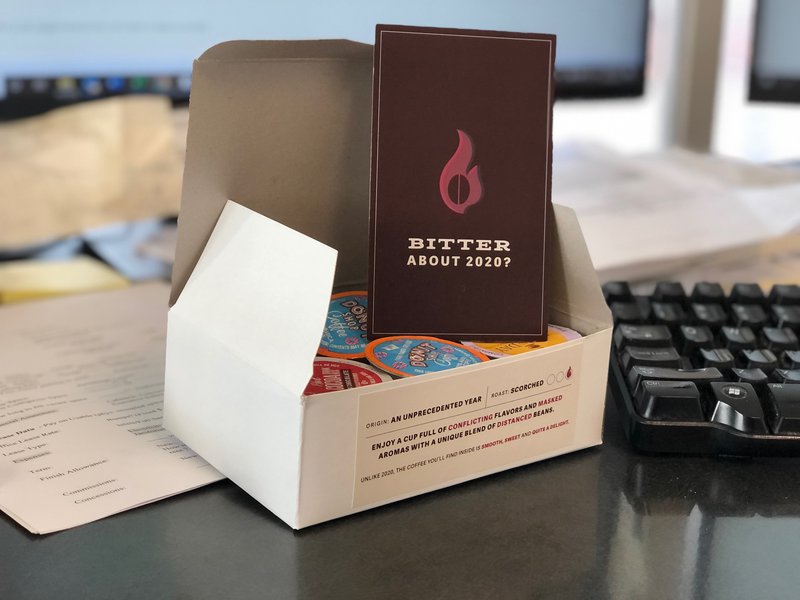
The good news? You don’t need to be a barista to pour yourself the pick-me-up you need to get over the final hump of a year full of toilet paper shortages, asterisked pro sports championships, fogged glasses, involuntary homeschooling, and endless Zoom-ing. All you need to beat back your well-earned exhaustion is a bold new brew from LPA.

This year, we’re not just sending our any old season’s greetings. We’re celebrating our love of coffee — or, as we like to think of it, “appraisal fuel” — with our clients, partners, and Team members in the form of a special package containing LPA’s Roast of 2020.
- Tasting notes: Our unique blend of distanced beans results in a cup overflowing with conflicting flavors and masked aromas. Sip with an abundance of caution.
- Origin: Singular. If we can say one thing about 2020 with any certainty at all, it’s that it was an unprecedented year.
- Roast: Think darker than darkest. As in, “scorched.”
All bitterness aside, the holiday gift we’re sending out this year makes for a smooth, sweet, and overall delightful experience. We know; that’s not very on-brand for 2020. But it does reflect our deepest wishes and sincerest hopes for 2021. Merry Christmas and a most invigorating New Year from all of us here at LPA!
Once again, Texas has taken first place on the Global Groundwork Index, a position the Lone Star State has held since the Index was created in 2018 by Site Selection magazine. As such, Texas continues to be a place where infrastructure investment is making an outsized impact on both the local economy and Texans’ key quality of life indicators.
Texas’s achievement is all the more remarkable considering the shockwaves 2020 has sent rippling through the commercial real estate landscape. As Chairman and CEO of CG/LA Infrastructure Norman Anderson observes, “The COVID-19 Black Swan has completely disrupted the U.S. and global infrastructure market, magnifying the cracks in the global infrastructure investment model. The magnitude of the problem is significant, but so is the opportunity.”
The federal deficit, which now tops $27 trillion, is only one factor in this equation. States and municipalities are facing significant budget shortfalls, too. Consequently, Anderson believes any post-pandemic rebound will be driven by accelerated private investment in highways, utilities, and other infrastructure projects. He points to an August ruling by the Federal Transit Administration (FTA) allowing the use of federal funds for joint development projects as an example of a pragmatic policymaking pivot that will have lasting long-term effects.
Does this trend jeopardize Texas’s ranking? Or does it promise to create even more jobs and drive even more business investment across Texas? To answer these questions, it helps to understand why Texas consistently ranks at the top of the Global Groundwork Index. We recently caught up with Mario Caro, LPA’s right-of-way valuation leader, to get his thoughts on the state of infrastructure investment in Texas, the industries, stakeholders, and regions driving that investment, and what the immediate future may hold for Texan landowners.
Growth Drives The Demand For Infrastructure Investment In Texas
Mario points to Texas’s wide-open spaces, energy richness, and surging population growth as drivers of infrastructure projects. These forces render infrastructure investment essential. “What other choice do we have with the growth and economic development occurring statewide?” he notes. “When you have so many new people moving here, you have to think about roads, water and sewer, getting electricity to the people who need it. Texas has to remain out in front of those needs.”
Texas is doing so, in part, by leading the way in renewable energy, particularly wind power along the Coastal Bend. According to Mario, “We look at it on a nationwide basis, and that industry is just going to keep growing, especially across South Texas. They have the perfect climate — the weather patterns — to generate this type of renewable energy.”
However, energy projects are not confined to the coast. Experts predict that oil and gas production in the Permian Basin will double over the next four years. Mario acknowledges that only by shoring up vital downstream, midstream, and upstream infrastructure will Texas be able to realize the full benefits of all this drilling and laying of pipeline. “There’s a good reason why TxDOT [the Texas Department of Transportation] won federal transportation funds for the Permian Basin. A lot of it has to do with addressing outstanding safety and connectivity issues in that part of the state. Farm-to-market and county roads to and from well sites and refineries, drainage areas — this infrastructure has rapidly deteriorated due to heavy use or become obsolete. Either way, it needs to be brought up to today’s standards.”
Public-Private Partnerships Create New Opportunities
Even in an economic powerhouse like Texas, state, county, and municipal budgets are feeling the strain of both increased public health costs and COVID-related declines in revenue. Moving forward, Mario says, the P3 or public-private partnership model will only play a more critical role in financing infrastructure projects.
As evidence of what the P3 model can accomplish, Mario cites the State Highway 130 toll road, an alternate route to I-35 (and Austin bypass) that runs from Georgetown south to Seguin. According to Mario, “the private side of the concession” is owned by a group from Spain and a San Antonio-based engineering firm. “Although there were some struggles with the southern segment of that stretch of highway — it wasn’t generating the expected revenue — the northern portion looks like it will pay for itself several times over,” Mario reports. “Plans are already underway to widen lanes to keep up with the increased traffic from Georgetown to the east of Austin.”
However, the P3 model is no guarantee of success. As Mario points out, partnerships can collapse when inequity is built into the arrangement. “In many instances of failure, it’s been the public sector that hasn’t been able to hold up their end of the bargain,” he explains. “The simple fact of the matter is that public authorities aren’t as accustomed to negotiating these types of agreements. The private sector has more experience in that realm, and they often walk away from the table having won more favorable terms. But some public agencies are making efforts to correct that: by calling in private consultants who can help the public sector negotiate better deals. That’s certainly a trend to watch closely.”
Texas Recognizes The Need For Diverse Infrastructure Funding Sources
Public infrastructure investment aims to support area businesses and improve the quality of life for all citizens. However, private investors are often responsible to their shareholders, who, in turn, want to see a measurable return on their investments. Consequently, there are real limits to the P3 model. As recently as 2019, more than three-quarters of all infrastructure projects originated with state and local governments. “There is no federal or national infrastructure mechanism to renovate bridges and upgrade wastewater treatment plants,” Mario adds. “So state and local governments must get creative when it comes to financing these projects.”
One way forward, Mario believes, is to capitalize on future land values. Speculators have become quick to buy up property surrounding planned infrastructure projects. They know the improvements will drive up land values. According to Mario, “Public agencies are now asking, ‘How can we partner up with the private side?’ They know where these projects are going; they know what they’re going to look like. With careful planning and collaboration with developers and investors, maybe these local governments can capitalize on those future land values, essentially raising money based on that appreciation to pay for their infrastructure needs.”
Where To Look For Future Infrastructure Projects In Texas
To quote Norman Anderson again: “The macro fact that dominates our thinking is an extraordinary pent-up demand for projects all over the world. … Could infrastructure investment swing the heavy lumber in a comeback from the COVID-19 deficit?”
Mario believes it could, especially in Texas. “There’s a hard ceiling to economic development, and right now, the U.S. is lagging behind other countries in infrastructure. In many cases, neglect is also an issue. The state has no other option but to step in and help out now.”
That means that Texas landowners who live in the path of growth or areas subject to heavy industrial usage — such as the Permian Basin — need to stay informed and up-to-date about the state’s infrastructure plans. “We’re going to start to see investment in more than just highways and transmission lines,” Mario predicts. “We’re going to see many more wind and solar projects, as well as infrastructure to safeguard communities from natural disasters.”
Indeed, a record-breaking hurricane season and other extreme weather events in 2020 suggest that climate-related risks will influence many infrastructure-related decisions made in 2021 and beyond. “We’ve had hurricanes; we’ve seen flooding in the Midwest and wildfires in California,” Mario explains. “These aren’t isolated events, and they require us to ask ourselves how we can improve our infrastructure to mitigate against the destruction they can cause.”
Mario also sees a need for infrastructure that more directly addresses human needs. He anticipates that Texas’ expanding workforce will precipitate higher demand for affordable housing, particularly in its urban centers. However, Mario also notes that “these are policy issues that may require housing subsidies or tax credits. Both would potentially affect property values. Along with this policy should come thorough and transparent public scrutiny. To protect the public interest, only those developers who offer up truly affordable housing should receive generous tax breaks and incentives.”
Whatever Texas’s position as a hotbed of “shovel-ready” infrastructure projects means for commercial real estate values, Mario predicts that landowners may be able to exercise more leverage than ever before. With the rise of P3 and entirely private projects, such as the proposed high-speed passenger train linking Dallas-Fort Worth and Houston, authorities may be more willing to purchase infrastructure-adjacent properties than condemn them outright.
“I’m interested to see if, or how frequently, private entities claim the right of eminent domain for these projects,” Mario says. “I think they may think twice before doing so. Invoking that right opens the door for more litigation and regulations. But will their hesitancy to seize property slow progress on infrastructure projects? Or will it help win over certain landowners who have been resistant to infrastructure investment in their back yard? And how might that reset fair market value benchmarks for what might otherwise be considered perpetual agricultural acreage? The implications for Texas’s economic health and vitality here are huge. But I’m confident we’re up to the challenge.”
The COVID-19 pandemic has forced organizations to swiftly adopt technologies that allow them to conduct their business remotely or shutter operations entirely. Overnight, even businesses still firmly rooted in 20th Century technology have learned to navigate Zoom meetings and virtual workplace platforms. In fact, as early into the crisis as May 2020, McKinsey reported that the U.S. had “vaulted five years forward in consumer and business digital adoption in a matter of around eight weeks.”
Throughout the pandemic, the commercial real estate industry’s tentative acceptance of property technology (proptech) has become more of an enthusiastic reception. Landlords, building managers, and business owners have embraced automated workplace safety solutions they might have deemed luxury items before March 2020.
As a result, more CRE stakeholders than ever have directly experienced the conveniences, cost savings, and other benefits proptech can deliver. Far from being a quick — or temporary — fix applied during an unprecedented public health emergency, these adoptions promise to help the industry future-proof itself for 2021 and beyond.
Which of these technologies are most likely to outlast the pandemic and become part of the commercial property industry’s standard operating procedures and best practices? Read on to learn more.
Contactless access
Although retailers have supported touch-free interactions for some time — for example, via “tap to pay” credit card readers — this technology has assumed new importance in the age of COVID-19. Moreover, in a CRE environment, “contactless” can mean many things.
- Smartphone apps that enable hands-free access to buildings and rooms.
- Hologram elevator keypads.
- RFID chip-embedded ID cards linked to cafeteria and parking garage POS systems.
- Ultra-wideband (UWB) digital keys that can swish open a door as a credentialed individual approaches.
As Catherine Sbeglia, writing for In-Building Tech, notes, these technologies were initially developed to enhance security. “But, now, employees and tenants want to feel safe from infection, so while a keyless product had merit a year ago, it has even more today.”
Look for these solutions to take hold in — and potentially aid in the revival of — the hospitality sector as well. As Hotel Technology News reports, several of the world’s largest hotel brands, such as Hilton, are “doubling down” on “contactless arrival experience[s]… [g]uests can check-in, choose their room, access their room with a digital room key, and check-out using their mobile devices.”
Workspace booking software
After months of working remotely, people have begun returning to offices — but not to business as usual. Public health guidelines still prescribe maintaining 6 feet of distance between individuals, which requires agility in managing workspaces.
Businesses are now repurposing workspace management software to help meet the challenges associated with stricter office density requirements. For organizations that have implemented an in-person/remote-work hybrid model, workspace management software is essential for tracking employee schedules and desk assignments. These same programs may also be used to create sanitization schedules and, should the need arise, provide data for contact tracing.
However, there are limits to this solution. As Guy Campos, writing for AV Magazine, points out: “Making desks into shared workspaces that are bookable and perhaps used by a different person each day can be a detriment to workplace culture and a feeling of belonging to a business.” And that sense of belonging impacts productivity. For the foreseeable future, the key for businesses will be to provide for employee proximity and collaboration while maintaining an appropriate level of social distancing.
Thermal cameras
While scanning individuals for fever isn’t a surefire way of identifying COVID-19 infections, many businesses and institutions are augmenting their screening methods with remote temperature scans.
To this end, thermal cameras are useful in detecting building occupants with elevated body temperatures. These cameras are already standard security equipment. When calibrated to measure body temperature, they can identify potential infections and activate alerts both locally and remotely. Thermal surveillance cameras may even be integrated with entry systems to create a first line of defense in high-traffic areas, both within a building’s interiors and on its grounds.
Antimicrobial materials
COVID-19 has placed a new emphasis on cleanliness, and these elevated sanitation concerns may justify the expense of antimicrobial coatings. Materials that can reduce the transmission of viruses and bacteria could become commonplace in mass transit and healthcare. And tenants may feel more at ease knowing the high-touch surfaces they come into contact with are germ-free by design.
But more progress may need to be made first. According to Tiffany Hua, Research Associate at Lux Research, “It is important to understand the limitations of these technologies. Metallic antimicrobial agents like silver and copper can be effective against both bacteria and viruses, but ensuring their effectiveness when dispersed in coating matrices still poses challenges.” Worse, overuse of these materials could cause bacterial and viral resistance, creating the superbugs health professionals fear most.
Nevertheless, Lux Research remains bullish on “antimicrobial research and funding,” noting that “major manufacturers like Ford Motor Co. are talking about incorporating these types of coatings into their products.” Closer to home, North Texas-based Allied BioScience is hard at work shepherding its antibacterial and antiviral coating through the EPA’s approval process. Should that occur, it could open the floodgates to a host of similar solutions, reducing the initial investment costs associated with their application.
Autonomous robots
Much of CRE and facilities management is bogged down with repetitive, routine tasks: collecting and posting payments, compiling legal documents, producing critical data reports, etc. With robotic process automation (RPA) software, organizations create software robots to handle these tasks. Coupled with artificial intelligence, these algorithmic robots develop the ability to process unstructured data and identify CRE market trends with real-time data harvesting.
Moreover, these scalable systems reduce the need for personal contact — an obvious benefit in the era of social distancing. Finally, in addition to improving efficiency by reducing human error, automated solutions free up personnel to focus on higher-value work.
WELL Building certification
Organizations have long understood that a healthy workforce is a productive workforce. But COVID-19 has forced many building owners and operators to reevaluate just how much their physical environments support employee health. Proper ventilation, air filtration, water quality, and moisture control have taken on a new urgency as more and more novel coronavirus outbreaks can be traced back to indoor gatherings.
Moving forward, the WELL Building Institute’s standards will increasingly serve as a guide for architects and designers. The organization offers a certification for properties that meet specific criteria for air and water quality, cleaning and sanitization, emergency preparedness, health services, communication, and innovation. Look for both new construction and adaptive reuse projects sporting a WELL Health-Safety Rating to command a premium, especially in urban markets.
Crowdfunding
Government financing regulations once put CRE ventures out of reach for most investors. The situation began to change with the 2012 JOBS Act and the launch of real estate crowdfunding. But the economic downturn created by the pandemic has been a mixed bag for the major players in this niche. Some crowdfunding platforms have far exceeded their capital requirements — and in record time — while others have struggled to navigate a landscape in which distressed assets have proliferated.
However, falling values have lowered the barrier to entry even further for prospective crowdfunders. As we’ve discussed before, CRE’s historic resilience in the face of recessionary pressures makes it an exceptionally attractive asset class at this time. Based on the YTD performance of REITs, industrial CRE and data centers have the potential to significantly outperform property types such as office, retail, and even healthcare.
Finally, CRE investments are officially no longer the exclusive domain of the ultrawealthy. In August 2020, the SEC expanded the definition of an “accredited investor” to include individuals with specific professional certifications or other credentials. This move has created an even larger pool of potential crowdfunders.
Virtualization of property listings
For years, the residential real estate market has been offering highly sophisticated virtual property viewings. However, CRE stakeholders have been slower to adopt this technology. Why? Because, at its core, real estate is a people-centered business. Video chats and virtual tours will never wholly replace face-to-face CRE transactions.
Nevertheless, mandated shutdowns during the early months of the COVID-19 pandemic set off a massive cultural shift in the industry. As many brokerages have recently discovered, virtual reality and augmented reality have tremendous potential for expanding their marketing reach.
Additionally, as shelter-in-place orders and building capacity limits have been extended for months rather than weeks, employees in most white-collar occupations have become accustomed to using cloud-based collaboration software and videoconferencing. The savings and convenience realized by eliminating the need for site visits may be enough to guarantee that this trend continues to rise.
Of course, proptech itself is not immune from the effects of the pandemic. Venture capitalists are currently more focused on rebalancing their portfolios than assuming the risks associated with backing startups experimenting with relatively unproven business models. But COVID-19 has also accelerated the pace of change across all industries. What seems far-fetched — and unmarketable — today may be essential tomorrow. As CRE valuation experts can appreciate, most proptech experts agree that those innovative solutions that leverage data and insights to make the experience of acquiring real property better overall enjoy the best long-term prospects.
CRE valuation experts are accustomed to having a robust set of tools at their disposal. Unfortunately, COVID-19 has transformed what was once a very reliable hammer into a stubbornly crooked nail.
Since March 2020, transaction velocity has slowed significantly. Real Capital Analytics (RCA) recently reported that July 2020 marked the fourth month in a row that U.S sales volumes across all property types fell by double digits. In fact, Q2 2020 was notable for all the wrong reasons. As RCA notes, “transaction volume dropped 68 percent to the lowest level for a second quarter since the Global Financial Crisis.”
CRE sales comps are literally few and far between. Actors moved to buy, hold, and sell for reasons that would have made little sense this time last year have only exacerbated the effects of this data scarcity.
How can appraisers guarantee that their reports contain credible, actionable business intelligence in a market where only illiquidity and uncertainty exist in abundance?
According to LPA’s own CRE valuation experts, five best practices have served them — and their clients — exceptionally well throughout the pandemic. Read on to learn more.
1) Avoid extraordinary assumptions
Appraisers are not fortune-tellers, and appraisals are not crystal balls. Appraisals are highly informed opinions backed up by as much data as the appraiser can muster. And, even when it is up-to-date, that data is always historical to some degree. Unless a choice has been made, an action taken, or a statement recorded, it cannot be referenced or analyzed.
That said, in stable markets that are following forecasts, appraisers can be more confident that what they observe today will not disappear altogether tomorrow. Even if they turn out to be false, such ordinary assumptions would not materially affect the appraiser’s conclusions regarding the value of a specific property. COVID-19 has elevated the risk involved in making such assumptions.
Appraisers need to become more comfortable dealing with the unknown for the time being. Of course, our profession remains upbeat about CRE’s resilience. The data we have regarding past economic downturns speaks to the nature and extent of that resilience. However, we cannot assume that the COVID-19 outbreak will be so short-lived that its effects will represent a mere blip in market performance. Buyers are not necessarily getting — and quickly recovering from — cold feet because of the pandemic. Deals may be taking longer to close because buyers need more assurances that the properties they are acquiring meet rigorous health and safety standards. Moreover, what look like delayed transactions may eventually reveal themselves to be leading indicators of a long-term shift in demand or supply.
Accuracy can be a moving target. It is not a transcendent ideal. It is contextual. At this time, one of the best approaches appraisers can take is to render that context more visible — and, in the process, their reports more transparent. That means appraisers must take full ownership of their opinions, support those opinions as best they can, and safeguard those opinions from being proven fundamentally mistaken no matter what the future holds.
2) Be collaborative
Comps may be elusive these days, but that doesn’t mean that valuable information has simply evaporated. If anything, the information that is available carries more weight than ever. Because it is more scattered and may be lurking in unexpected (or rarely probed) nooks and crannies, appraisers should anticipate that they will have to expend more energy in collecting that information.
However, appraisers should dedicate a portion of that energy to forming and strengthening their professional relationships. If information-gathering is more burdensome due to the pandemic, the solution to that problem is to put more shoulders underneath that load.
That collaboration should begin with participation in casual but thoughtful conversation. Who else is trying to gain a better understanding of what’s happening in the CRE market? Brokers are one such party, but appraisers should consider widening their social circles to encompass a diverse cohort of CRE stakeholders: lenders, property attorneys, government officials such as zoning officers, journalists, and scholars.
Appraisers should consider these conversations exploratory and be willing to answer as many questions as they pose. Before appraisers can bridge the data gap opened up by down sales, they need to achieve a bird’s-eye view of the market’s terrain. Fact-finding, on the other hand, requires a formal survey. The good news is that, having cultivated collaboration and a sense of community via those thoughtful conversations, appraisers have begun to identify a statistically significant sample population.
This summer, LPA conducted a survey to answer three pressing questions about CRE markets across Texas and the Southwest.
- What impact has COVID-19 had on property value?
- How has COVID-19 impacted cap rates?
- How has COVID-19 impacted occupancy rates?
Using this instrument, we were able to quantify anecdotal evidence we had gleaned from other sources, transforming it into more than 1,000 data points. You can learn more about this survey and download a copy of the Summary Report by reading the August 2020 installment of LPA Insights.
3) Examine deals as closely as you would sales
Surveys serve to emphasize another key point: in a pandemic, comps are no longer the be-all and end-all. In the absence of sales data, cost and income must play a larger role in appraisal methodology.
Digging into the finer details of a sale can provide illuminating information. This applies to acquisitions that aren’t even true property acquisitions. Here in Texas, major oil and gas companies have been increasingly trading in loans and notes to build up their cash reserves. Of course, property values still play a role in underwriting those assets. Meanwhile, those looking to liquidate both performing and non-performing inventory — especially in the hospitality and retail sectors — are generating new, 30- to 60-day valuation snapshots.
Under such conditions, cap rates alone aren’t likely to provide realistic projections. The suspension of nearly all social and business activity prompted by the pandemic caused revenues to plummet off a cliff. Appraisers eager to bolster their calculations should consider leveraging other analytical tools, such as NOI and DCF. Such tools also help appraisers avoid making punitive assumptions based on moment-to-moment market fluctuations.
Moreover, asking how a deal got made can highlight possibly emerging trends. What motivations and assumptions did both buyer and seller bring to the negotiating table? What concessions may have helped the deal go through? What other dynamics affected the sale, and how were they negotiated?
The goal of digging into “outside the bob” market data is not to stuff appraisal reports with filler. The goal is to learn as much about actual market conditions as possible. Those learnings will only give any hard data included in an appraisal report extra dimension and resonance.
4) View trends from multiple points of view
Similarly, extracting actionable market intelligence from this mixed and matched data will require a bit more imagination. As always, appraisers would be wise to follow industry news. Yet, now more than ever, appraisers must also read beyond the headlines and give equal consideration to opposing points of view. Doing so can help them sort out the short-term risks from long-term ones.
A case study can help illustrate this point. At the outset of the pandemic, businesses everywhere implemented full-time work-from-home policies. Sending workers home and asking them to stay there proved to be a low-impact and cost-effective way to adhere to social distancing guidelines.
Yet what value does office space possess in a world where everyone telecommutes? Unfortunately, extrapolating from this question can quickly turn into a form of spiraling, with one doomsday scenario after another emerging as an inevitable outcome of this cultural shift.
Worse, to not consider alternatives would be to ignore emerging counter-trends and offsetting market forces. After months of remote work, more and more employees have a renewed appreciation for the office. Elizabeth Brink and Arnold Levin of Gensler believe that the office of the future will be a “collaboration touchpoint.” Kelly Griffin, a principal at the architecture firm NBBJ, expects physical workplaces will become more “intentional… [places] to connect with others, leading to increased social space, amenities, and conference rooms.”
If Griffin’s description sounds quite similar to a co-working space, that may be no accident. If demand for flexible, reconfigurable, centrally located collaboration spaces rises in the coming months, so too might occupancy rates.
5) Invest even more in developing — and leveraging — your local market expertise
COVID-19-related uncertainty has amplified each local market’s unique characteristics. New York is not Los Angeles, and neither is Dallas — which just surpassed both cities as the top CRE market in the U.S. (by sales volume). To understand North Texas’ ascendance, it would help to ask someone who has boots on the ground there.
LPA’s appraisers have long understood the virtue of thinking and acting locally. They’ve also tracked the local effects of black swan events before. Hurricane Harvey ravaged the Texas Gulf Coast in August and September of 2017. The storm damaged over 700 businesses, whose hurricane-related losses ultimately exceeded $100 billion. Houston, Beaumont, Port Aransas, and several other cities began rebuilding in 2018. Those efforts led to labor and supply shortages, driving construction costs up — and keeping them there.
All across Texas, both landlords focused on IRR and tenants concerned about their leases felt these inflationary pressures. Now, the contraction in new and speculative construction prompted by COVID-19 may already be contributing to a welcome correction in construction costs.
Is this correction buoying new construction in markets like Houston, Austin, San Antonio, and Dallas-Fort Worth? Very possibly. But the real lesson here is that it takes local market expertise to recognize a variable such as this — much less factor it into an appraisal and assess how consequential it is to the accuracy of the final valuation report.