
LPA’s Research Team Believes CRE Will Remain Resilient in 2023. Here’s Why.
Last month, we asked LPA thought leaders Jake Allen (Director, LPA Lubbock), Drew McFarland (Senior Managing Director, LPA Dallas), and Mark Lowery (Principal and CEO) to discuss what they expect from the commercial real estate (CRE) industry in 2023.
Overall, Jake, Drew, and Mark believe CRE will continue to attract buyers and investors over the next 12 months, with industrial and multifamily properties across the Southwest continuing to outperform asset classes in other markets. But they also agree that a big question is looming: will 2023 be as up-and-down as 2022 was?
So we asked the LPA Team members who take daily deep dives into market data and trends — Senior Associate Researcher Andrew Burns and Associate Researcher Ashley Travis — to share their unique expertise and perspectives on this and several related questions.
The Role of Research at LPA
Before we reveal what Andrew and Ashley see on the horizon, we want to provide some important context for their observations and conclusions: a full account of their day-to-day life at LPA.
The bulk of Andrew and Ashley’s work consists of:
- Extracting transaction and market data from multiple sources, both industry-standard (CoStar) and niche.
- Aggregating that data.
- Organizing that data and attaching it to specific appraisal projects in LPA’s proprietary database.
- Constantly updating that data to keep it as current — and relevant — as possible.
- Visualizing this data in the form of tables and charts that populate LPA’s appraisal reports.
- Working on special projects. Such projects have included:
- Conducting — “from scratch” — market analyses for new asset classes and locations.
- Managing an investment survey sent to 400-plus stakeholders.
- Creating a new standard element of all LPA appraisal reports: an economic update tracking unemployment, energy prices, etc., and noting these economic factors’ potential impact on property values.
“Our goal is to give the appraisers more bandwidth so they can work more efficiently,” Ashley summarizes. How much more efficiently? Andrew has done the math. “On average, we’re working 10 to 15 projects a day,” he says. “Over the course of a year, that’s more than 3,000 projects where the appraiser can focus on providing their analysis and unique insights.”
Staffing a dedicated Market Research Team has been instrumental in helping LPA grow while maintaining its reputation for 100-percent on-time delivery and exceptional customer service. An anecdote from Andrew illustrates how. “The typical turnaround time for an appraisal report is approximately three weeks. But as the economy has softened and transaction volume has slowed, we’ve taken on more projects that need to be turned around in 1 week,” he says. “Being able to lean on a dedicated research team gives our appraisers the agility they need to meet those accelerated deadlines.”
1) Based on its 2022 performance, which property type/asset class is facing the strongest headwinds entering 2023?
For Andrew and Ashley, the answer is crystal clear: office.
This is partly because office properties are caught up in what may prove to be the most significant and enduring cultural change to occur during the pandemic: the shift to fully remote and hybrid work.
A study conducted by the U.S. Survey of Working Arrangements and Attitudes (S.W.A.A.) in December 2022 found that employees prefer to work from home three days a week. Their employers, however, would prefer to see that number drop closer to two days per week. Although, as The New York Times reports, “that’s not a big gap in expectations,” hard stances against remote work taken by prominent business leaders like Elon Musk and Bob Iger suggest otherwise.
“Analysts at Moody’s found that office vacancies dipped in 2022 but are not yet back to pre-pandemic levels. So, companies are going back to the office. But they’re proceeding slowly, and not as many are returning.” Andrew posits. “It will be interesting to see what companies will do. Will they issue ultimatums or offer perks and amenities to get employees interested in office life again?”
However, time may be running out. Ashley believes 2023 will be “a make or break” year for office. “Many leases are expiring, meaning vacancy rates could spike, driving down the value of surrounding properties,” she cautions. “A lot is riding on the decisions corporate executives make in the coming months. State-of-the-art Class A buildings with modern amenities should continue to perform well, but demand for older buildings will probably be soft. We may even see some properties that would have been considered Class A before the pandemic downgraded to Class B.”
2) Which asset classes might actually benefit should inflation continue to climb in 2023?
Andrew expects industrial to do as well, if not better, in 2023 than in 2022. Why? “As companies continue to increase the production of goods that have been in demand since bouncing back from the pandemic, they will need to continue renting or buying warehouses to store that inventory. Because of this and the growth of e-commerce, industrial looks to be an asset class that can hold its value even if consumer activity causes inflation to heat up,” he explains.
Adds Ashley: “Many retailers are likely switching to a strictly e-commerce presence and need fewer storefronts. But they’re replacing them with distribution centers and last-mile delivery services.”
From 2017 through 2021, the last-mile delivery segment achieved a compound annual growth rate (CAGR) of more than 18 percent. Third parties specializing in freight and trucking have benefitted the most from the consumer demand for same- and next-day shipping, but logistics-as-a-service providers are poised to reap more of those benefits in 2023. At the beginning of the year, Amazon announced that it would be significantly expanding its Buy with Prime program, which “allows merchants to pay Amazon a fee to store and deliver products, handle returns, and process payments.” Amazon certainly has warehouse space to spare, having acquired over 260 million square feet of industrial since 2020.
3) Which markets in the Southwest are primed for continued growth in 2023?
When ranked according to such key metrics as “workforce,” “cost of doing business,” and “technology and innovation,” Texas is one of the most business-friendly states in the U.S. Even in the face of a possible recession, economists remain bullish on Texas because of its low unemployment and population growth.
These trends most favor the Lone Star State’s major metropolitan areas. “As Texas’ big cities draw more and more people to relocate there, we expect to see increases in almost every asset class. Those major metros also have the infrastructure to handle the increased demand for years to come,” observes Andrew.
Among those asset classes, Ashley sees the greatest potential for growth in multifamily in Dallas-Fort Worth, Houston, Austin, and San Antonio. “The multifamily sector shows no signs of slowing down as many people migrate to the area,” she says. “Many consumers will remain renters as well, considering current home prices and high interest rates. This leads to greater demand for affordable housing and apartments.”
Waco, an up-and-coming market in Central Texas, may be leading the way in satisfying that demand. Last September, its Tax Increment Financing (TIF) Zone board allocated almost $3 million to “subsidize the construction of workforce housing” on city-owned land.
4) Which proptech innovation will have the most significant impact on the industry in 2023?
Ashley sees the greatest potential in the industrial metaverse and digital twins. “Many multifamily properties already use 3D models to allow stakeholders to view spaces virtually and take measurements,” she explains. “As other sectors adopt virtual and augmented reality technology, it will enable appraisers to save time on inspections and work more efficiently.”
Andrew, on the other hand, believes robotic process automation (RPA) and advanced data orchestration will alter the CRE landscape even more than they already have. “We’ll see an increase in the use of artificial intelligence (AI) in 2023 as it becomes more highly developed and more companies lean into using it,” he predicts. “Some companies are also already connecting their AI functions to the blockchain so they can secure this automated data more efficiently. It’ll be interesting to see how AI might help our appraisers be even more accurate and efficient.”
5) What one word sums up the commercial real estate outlook for 2023?
Andrew’s choice is “competitive.” Why? “As transactions decrease, demand for the most up-to-date data and trends will increase. Investors want the latest information to help them navigate what’s always a volatile market,” he asserts. “At LPA, we understand that we need to stay on the cutting edge of technology and integrate it with our business and systems.”
Ashley opts for “resilient,” and her reasons have much to do with technology, data, and the enduring value of business intelligence. “The CRE industry has always been and will always be cyclic,” she notes. “Using innovative proptech and better data, the industry will demonstrate that it’s capable of navigating challenges and adapting to present economic conditions.”
LPA’s valuation services span the complete spectrum of commercial real estate property types, including those unique asset classes that require additional attention, research, and assessment.
- Retail, from strip centers to restaurants, bars, and taverns.
- Office, including suburban offices and medical and dental buildings.
- Industrial: manufacturing facilities, warehouses, distribution centers, data centers, and more.
- Multifamily: apartments, condominiums, townhomes, duplexes and triplexes, senior housing, mobile home parks, etc.
- Developments and subdivisions, including age-restricted and master-planned communities.
- Self-storage facilities (indoor, outdoor, climate-controlled, etc.).
- Hotels, motels, extended stay lodging, resorts, and casinos.
- Car washes, auto repair shops, auto dealerships, and gas stations.
- Special purpose: schools, places of worship, sports facilities, assisted living facilities, parking lots, going concerns, and more.
- Vacant land, from greenfields to lakefront properties to forest holdings.
- Right-of-Way and Eminent Domain
No matter what your commercial property valuation needs might be, the regional experts on our Appraisal and Market Research Teams will provide you with accurate, USPAP-compliant reporting and on-time delivery every time.
Contact any of our 8 Texas locations today to learn more about what we do and the clients we serve.
In many ways, the story of commercial real estate in 2022 is a tale of two years.
Despite the outbreak of war in Europe and yet another COVID-19 surge, almost all asset classes outperformed expectations in Q1 and Q2. The chief reason? The market’s demand generators, such as low unemployment, the high cost of the average single-family home, and robust consumer spending — buoyed in part by another round of American Rescue Plan stimulus checks — continued humming as loudly as they did in 2021. Consider the following statistics:
- Between April 2021 and April 2022, 551 million square feet of industrial space were sold and/or leased across the United States, setting a new record. (Marcus & Millchap)
- As of June 2022, the national median rent for an apartment crossed the $2,000 threshold. In one Texas market — Austin — rent had risen 48 percent in twelve months. (Redfin)
- In Q2 2022, the average asking rent for shopping centers rose by 1.2 percent. Meanwhile, shopping center vacancy rates fell to their lowest level in 15 years: 6.1 percent. Consumers acting on their pent-up desire for in-person shopping experiences helped this beleaguered sector show such resilience. (Cushman & Wakefield)
But the script flipped in Q3 and Q4. The market’s strong fundamentals proved to be no match for the rising cost of capital, driven primarily by interest rate hikes intended to curb inflation. In October, the Mortgage Bankers Association (MBA) forecast that multifamily lending would see a 7 percent year-over-year drop by the time the books were closed on 2022. About that same time, the National Association of Realtors (NAR) reported that “about 1.34 million more square feet of office space was vacant and placed on the market than were leased” between July and September.
What does all this mean, if anything, for 2023? What forces and factors are most likely to affect transaction volumes, net absorption rates, and property values in the coming year? For answers to these and other questions of particular concern to CRE stakeholders, we asked some of the most astute observers we know: LPA’s own commercial appraisers. Keep reading to access their insights and expert opinions.
Which 2022 Trends Should Stakeholders Be Paying the Most Attention to in 2023?
“Interest rates are at the top of everyone’s mind, and I’m no different,” says Jake Allen, Director of LPA Lubbock. “The cost of financing affects activity levels across the entire real estate market.”
On December 14th, 2022, the Federal Reserve raised its benchmark interest rate by another 50 basis points. The bad news: the federal funds rate is now the highest it’s been since before the global financial crisis of 2008 – 2009. The good news: this increase was lower than expected. In fact, it broke a streak of four straight three-quarter point hikes dating back to June 2022. Most market experts believe the federal funds rate will top out at around 5 percent sometime in 2023.
Drew McFarland, Senior Managing Director, LPA Dallas, is closely monitoring both inflation and interest rates. But he’s looking at both through a slightly different lens. “Stakeholders should be on the lookout for rising construction costs as well,” he advises.
Adds Mark Lowery, Principal and CEO, “2023 is a potential wake-up call on cap rates.” How so? “Most in valuation theory agree that cap rates move in tandem with interest rates. While it’s not always a direct or instant correlation, the two clearly impact one another,” Mark explains. “Most CRE is leveraged, and when market participants are making decisions, their cost of capital is always a consideration. Right now, deal flow has slowed. Many are sitting on the sidelines, holding onto their capital and waiting to see what happens.”
Jake concurs. He also places the current slowdown in a broader context — one that gives him cause for optimism. “The current slowdown hasn’t come close to what we saw at the height of the pandemic in 2020,” he observes. “I believe most market participants share this sentiment and are confident that conditions will soon improve.”
What Other Factors Are Likely to Influence Commercial Real Estate Markets in the Coming Year?
Mark expects that consumer behaviors will continue to shape commercial real estate markets nationwide. But the buying habits he’s talking about are not specific to real property transactions. Citing the seemingly insatiable demand for industrial, Mark predicts that “the last-mile demand generated by the continued expansion of online commerce will continue to prop up that asset class.”
Drew, whose office serves the fourth-largest metropolitan area and the hottest commercial real estate market in the United States, believes the shifting employer-employee power dynamic will continue to be impactful. “The way work is carried out is still evolving following the pandemic,” he says. “This continual change can directly influence the need for commercial real estate. Office will likely remain soft due to the work-from-anywhere trend.”
For Jake Allen, however, the cost of energy — a significant contributor to the summer 2022 spike in inflation — is always top of mind. “Oil and gas prices directly affect the West Texas markets in which I specialize,” he notes. “Those prices don’t just affect the transportation industry. They affect just about every part of Texas’ infrastructure.”
Which Asset Classes Will Perform Better in 2023 Than in 2022? Which Will Perform Worse?
Both Mark and Jake are bullish on multifamily. “With the high cost of financing, I believe multifamily properties will see the biggest growth,” Jake says. He adds that he’s “keeping a close eye” on the single-family rental market. Although the housing market has cooled considerably since then, as of August 2022, single-family built-for-rent construction starts were up 60 percent YOY. What remains to be seen is whether institutional investors continue to bet big on this asset class. Some indicators point to several key players looking to cut their losses if not leave the space entirely.
Meanwhile, Mark points out that “multifamily has remained frothy for a number of years.” But he also sees reason for cautious optimism. “Cap rates have compressed low enough that increased interest rates will undoubtedly soften this asset class,” he says. “There will be heavily leveraged investors who will undoubtedly get stuck with their hand in the proverbial cookie jar.”
How Can Appraisers Keep Current with Emerging Commercial Real Estate Trends in 2023?
Jake says that keeping in front of emerging trends starts with continually honing his analytical skills. He is on track to earn his MAI designation in 2023 and plans to continue his studies and classwork even after achieving the profession’s “gold standard.”
Drew emphasizes the more informal education that comes from being a good colleague and active citizen. “Staying connected and active in local industry groups furthers my understanding of the field and the dynamic market we serve,” he says. Jake agrees, sharing that “the day-to-day of appraisal requires conversations with a wide variety of market participants. I believe speaking with them is incredibly educational.”
As Principal and CEO, Mark has already created a growth plan to ensure that LPA can maintain a front-edge understanding of trends as they emerge. “We’re doubling our research efforts to provide our clients the most up-to-date, accurate, and ethical opinions of value possible, and we’re significantly expanding our Market Research Team,” he reveals. But, for Mark, research entails much more than crunching numbers. Like Drew and Jake, he believes it involves building lasting relationships with trusted partners. “There’s no substitute for the human factor,” he explains. “There’s just no foolproof substitute for calling and emailing market participants.”
Next month, we’ll hear from Andrew Burns, Senior Associate Researcher, LPA Dallas, and Ashley Travis, Associate Researcher, LPA Dallas. They’ll discuss what they’ve learned from the volatility of 2022, what they’re forecasting for 2023, and how they’re using every conceivable tool to deliver actionable business intelligence to their clients.
LPA operates multiple offices in Texas, and our professional network extends far and wide. We’ve likely appraised a commercial property in almost every city and town in the Lone Star State — and we’re proud to say so. We also provide commercial real estate appraisals outside Texas, and our market footprint continues to grow rapidly.
Whether you’re located in Dallas, Fort Worth, Houston, Austin, San Antonio, Corpus Christi, Lubbock, El Paso, New Mexico, Oklahoma, Arkansas, Louisiana, or somewhere in between, we look forward to providing you with an exceptional customer service experience featuring best-in-class research, principled expertise, open communication, and 100% on-time delivery. To learn how you can put our Team’s market knowledge, geographic competencies, and property-type expertise to work for you, contact any of our 8 locations today.
It arrives every year at this time, ushered in with silver bells and stores full of new toys. But there’s a big difference between celebrating the holiday season and upholding its generally recognized ethical and performance standards.
So, before you hang an oversized stocking from the mantel, haul out the holly, slice up the fruitcake, or place a single present under the tree, please acquaint yourself with the current Definitions, Standards Rules, Elf Advisory Opinions, and FAQs found in the newly released Uniform Standards of Christmas Appraisal Practice (USCAP).
This very unofficial addendum to the Uniform Standards of Professional Appraisal Practice (USPAP) applies through the end of the year. However, despite USCAP’s limited scope, violations can bring some unhappy penalties: candy-cane fines, lumps of coal, or even a place on the naughty list. More importantly, failure to comply with USCAP could trigger an across-the-board decline in Christmas spirit: fewer carolers, more “bah, humbug”-ers, and widespread Krampus sightings, even by children who aren’t misbehaving.
Now, you may be asking: “Who developed these standards, what do they require, and how are they enforced?” All good questions.
The Congressionally authorized Christmas Appraisal Foundation (CAF), a consortium of the jolliest old elves from North America working in consultation with the North Pole’s resident experts, is responsible for the development of USCAP. The CAF’s purpose is to offer guidelines (in a gingerbread framework) of common terms and procedures for developing, assessing, and reporting cheer during the holiday season, roughly defined as Thanksgiving through New Year’s Day. That said, extending these parameters in either direction is in keeping with the generally accepted principle of Joy to the World.
USCAP covers a broad range of topics, from suitable apparel for holiday gatherings to appropriate gift-giving practices and feasting protocols. Moreover, they are descriptive, not prescriptive. The elves who have issued these Advisory Opinions have taken into account that Christmas traditions vary widely from region to region.
For example, paper bag luminarias line the walkways of the Southwest while New Englanders gleefully wrap strings of LED lights around snow-laden firs. Some holiday tables feature a stuffed goose; others serve up clove-studded hams. Whatever the case, USCAP does not endorse one set of traditions over another. They only require that appraisers correctly utilize methods recognized by and acceptable to all stakeholders, holidayers, and holidayees.
We recommend you pour yourself a generous serving of eggnog and follow this link to familiarize yourself with this important document. We’d like to think that your holidays will be merrier and brighter having done so. Merry Christmas and Happy Holidays from everyone here at LPA!
Trust is an essential ingredient of any commercial real estate (CRE) appraisal report. At LPA, we believe our clients deserve to work with appraisers whose property type expertise, analytical acumen, and knowledge of the latest industry trends are only exceeded by their commitment to principled conduct.
For that reason, we invest heavily in our people’s continuing education and professional development. Many of the leaders of our 8 Texas locations have earned certifications and designations that attest to their honesty, sincerity, transparency, and credibility.
But what do acronyms like MAI and AI-GRS actually mean? More importantly, how do they translate into added value for anyone in the market for CRE appraisal services?
Keep reading to learn more.
Licenses, Certifications, and Designations: What’s the Difference?
First, we need to draw a distinction between licenses, certifications, and designations.
Licenses are essentially permits to practice a trade or profession. They are administered by government agencies, most commonly at the state level. Licensing credentials are not always transferable from state to state. But nearly every state in the U.S. offers some form of reciprocity to real estate appraisers. Under the terms of reciprocity, a licensed appraiser in one state can apply for the equivalent license in another state.
In Texas, The Texas Appraiser Licensing & Certification Board (TALCB) provides education and licensing services, as well as enforcement of state and federal laws governing appraisals of residential and commercial properties. Certified General Appraisers are licensed to appraise all types of real property in Texas regardless of that property’s complexity or transaction value. They are also authorized to appraise both federally related and non-federally related transactions.
To become a Certified General Appraiser in the state of Texas, applicants must:
- Hold at least a Bachelor’s degree.
- Complete a course of study approved by the Appraiser Qualification Board.
- Acquire 3,000 hours of appraisal experience. Half of these hours must involve work on non-residential properties. (The TALCB handles licenses and certifications for residential appraisers differently.)
- Pass a license exam.
- Meet the TALCB’s standards for honesty, trustworthiness, and integrity.
Certified General Appraisers must renew their licenses every two years. Renewal requires additional professional education: the completion of least 28 hours of appraiser continuing education (ACE) courses from approved providers. These 28 hours must include a seven-hour course covering updates to the Uniform Standards of Professional Appraisal Practice (USPAP).
Certifications, like licenses, offer proof of a professional’s qualifications. Unlike licenses, certifications are issued by non-governmental organizations (NGOs) and institutions. Consequently, they are voluntary and not required for practice.
If licenses and certifications attest to a professional’s core competencies, designations denote that a professional has chosen to deepen their expertise or hone a particular job skill to a fine point.
Designations are typically available only to dues-paying members of professional associations who agree to meet a set of requirements. These requirements almost always include a robust educational component. As Mark Arvé, Managing Director of LPA Dallas, observes, “Designations are the outcome of a sustained intellectual curiosity blended with peer-reviewed professional experience that yields a demonstrated professional proficiency. In a sea of potential appraisal vendors, it’s reassuring to know that a designated professional will invest in each project to ensure the most credible assignment results.”
For this reason, designations tend to convey more authority — and carry more weight — than certifications. In the commercial real estate appraiser profession, the two most prominent of those designations are the MAI and AI-GRS. Being a licensed Certified General Appraiser is one of the first qualifications for applying for either. As Chellie Hoover, Managing Director of LPA El Paso, puts it: “If you want a job, get your state license. If you want a career, get your MAI designation.”
MAI
The Appraisal Institute is the largest association of real estate appraisers in the world. Its MAI designation is considered the “gold standard” within the profession by many banks, lenders, investors, and developers. As LPA President and CEO Mark Lowery explains, “The MAI is like the CPA of commercial appraisal. It’s not required, but it’s hugely impactful. For me, it’s been imperative to success. LPA would not be where it is today had I not obtained the MAI designation prior to launching the firm.”
The MAI is held in such high esteem for several reasons.
- The MAI’s education requirements, which include comprehensive exams and an (optional) thesis or dissertation, are nearly as rigorous as those in any Ph.D. program.
- The MAI is reserved for valuation professionals who can demonstrate a wide range of expertise. That range of expertise includes commercial, industrial, agricultural, and residential properties, plus professional services beyond standard appraisal reports.
- All MAI-designated appraisers must be of strong moral character and pledge to uphold the Appraisal Institute Code of Professional Ethics and Standards of Professional Practice. In fact, “MAI” stands for “Member, Appraisal Institute.”
- To retain their MAI designation, appraisers must stay up to date on industry trends and best practices.
Given the thousands of hours of education credits and specialized experience appraisers must accrue to earn the MAI designation, it takes the majority of candidates years to do so. The MAI is therefore more than a credential. It is a commitment only those with a rare passion for inspecting properties, providing opinions of value, writing reports, and advising clients on their CRE investments are likely to keep.
Clients seeking appraisals for projects that involve complex financing or interstate commerce must often secure the services of an MAI-designated valuation professional out of necessity. However, whether the project requires the oversight of an MAI-designated appraiser or not, their opinions are always highly regarded. According to Chellie, “The MAI designation helped me to level the playing field, especially working in a male-dominated profession.”
AI-GRS
The AI-GRS designation is also offered by The Appraisal Institute. It is reserved for valuation professionals who provide real estate appraisal reviews. (The “GRS” stands for “General Review Specialist.”)
USPAP defines an appraisal review as “the act or process of developing and communicating an opinion about the quality of another appraiser’s work that was performed as part of an appraisal or appraisal review assignment.” In some instances, an appraisal reviewer will simply offer a “second opinion,” or assurances as to the credibility and accuracy of an existing opinion of value. Most appraisal reviews are requested by lenders, investors, or buyers looking to minimize their exposure to risk. Appraisal review is an important part of the due diligence process for such transactions. However, attorneys may solicit appraisal reviews to support litigation. Because right of way and eminent domain (ROW/ED) projects can lead to legal disputes, the AI-GRS designation is highly sought after, both by appraisers who specialize in these areas and condemning authorities.
Even attorneys who do not request a formal appraisal review may wish to call an appraiser with an AI-GRS designation as a witness. “Speaking from the standpoint of providing expert testimony, we as testifying appraisers are requested to provide our qualifications, credentials, and experience to the commissioner or jury panel to provide support that we are indeed qualified to provide testimony as an expert witness,” says Will Snider, Director, LPA Fort Worth. “As part of that support, we will refer to designations and certifications (i.e., MAI, SR/WA, R/W-AC, etc.) achieved and provide a short statement about the steps involved in obtaining them. Taking these extra steps to become more of an expert in your field will assist in qualifying yourself before a jury.”
Candidates for the AI-GRS designation must meet many of the same requirements as candidates for the MAI designation. However, they do not have to satisfy a “Demonstration of Knowledge Requirement,” which can take the form of a research project, a peer-reviewed publication, or a dissertation (among other options). Instead, AI-GRS candidates must accrue at least 1,000 hours of appraisal review experience and 4,500 hours of professional experience overall.
Designations Not Specific to the Appraisal Practice
To further enhance their professional standing, some appraisers may also choose to earn designations that testify to the comprehensiveness of their commercial real estate expertise. Some of the more notable of these include the CCIM, the MRICS, and several designations administered by the International Right of WayIRWA).
Professionals who have earned the CCIM are recognized thought leaders in commercial real estate investing. CCIM-level expertise in market and financial analysis can be extremely valuable for clients seeking appraisals of complex properties.
The MRICS designation is administered by the Royal Institution of Chartered Surveyors (RICS), a professional organization founded in the United Kingdom over 150 years ago. In the commercial real estate field, the MRICS is understood to be equivalent to the MAI. Appraisers working internationally, or on large-scale, multinational infrastructure projects such as ports, may benefit the most from being able to present an MRICS designation.
IRWA offers both a certification specific to right-of-way appraisal — the R/W-AC — and a tiered program for generalists in the field. The RWA (Right of Way Agent) is the first level of achievement in this program, followed by the RWP (Right of Way Professional) and the SR/WA (Senior Right of Way Professional). Only professionals who hold a Bachelor’s degree in an approved discipline, have at least five years of relevant experience, and can prepare appraisals for ROW/ED purposes qualify for this prestigious designation.
Eleven of LPA’s valuation experts have earned an MAI or AI-GRS designation, and four of them hold both. Our practice leaders in ROW/ED have earned designations from IRWA, including the SR/WA. You can learn more about these accomplished appraisers, their areas of specialization, and their commitment to upholding their profession’s best practices and highest ethical standards by visiting the “Meet the Team” section of our website.
In June 2022, the national inflation rate inched past 9 percent. That’s more than seven points above the Federal Reserve’s (Fed’s) target rate. Although prices for some consumer products seem to have plateaued or dropped, Kiplinger forecasts that high inflation will carry over into 2023. Kiplinger also predicts that an economic slowdown will lower the inflation rate to 3.5 percent by the end of next year.
Whatever happens over the next several months, inflation has already sent shockwaves through the commercial real estate (CRE) landscape. For CRE stakeholders, inflation isn’t a matter of “if.” It’s one of “for how long, and to what extent.”
For this article, we asked our appraisal experts to discuss how the CRE market tends to respond to inflationary conditions and place today’s record-breaking inflation in a historical context. We also asked them to answer the most pressing questions they’ve received from brokers, lenders, landlords, and investors about inflation and commercial property values. Keep reading to access their unique insights.
Inflation and Commercial Real Estate: The Conventional Wisdom
Investors have traditionally considered CRE a solid hedge against inflation. Rents are sensitive to inflation, meaning income from short-term leases almost always rises as prices of other goods and services do. Many long-term rentals often include escalator clauses linked to the consumer price index (CPI). Consequently, CRE is usually capable of producing a reliable income stream whose value is not eroded by price spikes.
That said, markets are complex. Inflation’s effect on real property values and operating income will vary depending on which economic forces are driving it. For example, inflation caused by economic growth translates into rising rents and low vacancy rates, which is good for almost all property types. On the other hand, steep increases in the cost of raw goods, energy, or wages can reduce a company’s production capacity. As employers cut jobs to control their expenses, the economy can slip into recession. Under these conditions, property owners can expect increased vacancies, making it difficult to pass their rising costs on to tenants.
Although property values tend to increase in proportion to inflation, these are extraordinary times. Historical data from The Great Inflation (1965-1982) may not provide much guidance. We are dealing with a different economy, different monetary policies, and the lasting effects of a once-in-a-century pandemic.
On a more positive note, if a recession does occur due to inflation, a solid foundation already exists for the economy’s eventual recovery. The consensus among most economists is that 2022 is fundamentally unlike 2009, when a broken banking system, excessive risk-taking, and high levels of personal debt precipitated The Great Recession.
Inflation and CRE: Frequently Asked Questions (FAQ)
How Can Inflation Impact CRE Supply and Demand?
Inflation can reduce future CRE inventory. The main culprits here are rising construction costs, such as labor and building materials like concrete, and more expensive financing. (As we’ll see, higher interest rates are among the Fed’s favorite inflation-fighting tools.) Developers may even halt work on new projects entirely, buying time to determine whether they’re still financially viable.
Of course, any slowdown in new construction places a premium on existing properties. This is certainly the case in the multi-family sector right now. Rents have been keeping pace with the CPI, and the national occupancy rate is hovering around 96 percent. In fact, because inflation is driving up both home prices and mortgage rates, it’s simultaneously cooling the housing market and stoking demand for rental units.
How Do Policies Intended to Control Inflation Affect CRE Values?
In March of this year, the Fed began introducing a series of interest rate hikes that have since pushed the short-term lending rate up by 2 percent. Indications are that more increases are coming. How borrowers respond remains to be determined, but signs point to at least a modest drop in transaction volumes, and more so where pandemic-distressed asset classes, such as office and retail, are concerned.
Interest rates can affect any given commercial property’s value, but supply and demand, income potential, and operating costs are just as meaningful. Monetary policies indirectly affect all these variables. Deals generate much of the data that CRE appraisers rely upon to form reasonable opinions of value, but experienced valuation experts know how to make use of all available sources of information when the clouds start to outnumber the market’s silver linings.
How Exactly Do Commercial Real Estate Prices Factor into Appraisals and Valuations?
Sales data from recently sold comparable properties gives commercial appraisers insight into the current market. As noted, however, comparative market analysis (CMA) is only part of a comprehensive appraisal. Appraisers also research net operating income (NOI), capitalization rates (cap rates), vacancies, property history, and depreciation, weighing these and other data points to arrive at an accurate value.
How Can Inflation Affect an Appraiser’s Ability to Perform Comparative Market Analysis?
In inflationary periods, real estate values can change rapidly as wary buyers pull back demand. Comparative market data (comps) may be outdated before an appraisal report is completed. That’s one of the reasons why LPA is committed to 100-percent on-time delivery — a commitment we can meet with our state-of-the-art technology and access to rich data. We base our analyses on the most current data and deliver those analyses so that you can act quickly on that time-sensitive information.
How Does Inflation Affect Cap Rates?
Following interest rates, cap rates generally rise as property values increase. Re-pricing rents on multi-family, self-storage, and other properties with short-term leases to keep pace with inflation can increase NOI and help compress cap rates.
Does Inflation Make One Valuation Method More Useful than Another? How Do Appraisers Adjust Their Methodology Under Inflationary Conditions?
As Mitchell Austin, Senior Managing Director at LPA Dallas, explains, the best appraisers draw on their experience and knowledge of local markets to determine the most appropriate valuation method, or combination of methods, to use. This is true no matter what the inflation rate might be. “For example, during times of inflation brought on by supply chain shortages, we tend to see some obsolescence in new construction until pricing of market transactions can catch up with rising construction costs,” he says. “Most market participants would prefer to acquire an existing property that fits their needs rather than incur the time and effort of new construction. Until construction becomes cost/time prohibitive, market transactions will remain below the cost approach.”
The best appraisers also understand that inflation can affect every asset type differently. Currently, existing industrial and multi-family properties are experiencing near-full occupancy rates and rising rents (although Q3 2022 results suggest demand may be easing off). These properties are better positioned to hold their value as the reliable stream of income they generate may make higher borrowing costs more acceptable.
That may not be the case for office properties still sitting half-empty due to the widespread adoption of remote work. Upscale amenities are becoming more desirable as businesses seek to give their people more incentives to return to their pre-pandemic work habits. When appraising this asset class, highest and best-use valuations may be more relevant than in the past.
Which Property Types Are Most At-Risk Because of Inflation?
Properties with long-term leases, such as large retail complexes or warehouses, are the most vulnerable. Built-in rent increases of 2 or 3 percent may have been safe bets at one time, but these properties will experience declining returns as the inflation rate rises beyond contracted increases.
New developments may also prove risky as materials and labor make building more costly, requiring more financing at higher interest rates.
Which Property Types Might Actually Benefit from Inflationary Conditions?
Existing properties subject to short-term leases — multi-family, mobile home parks, self-storage, hospitality — can generate reliable streams of revenue that keep up with inflation. Provided the overall economy and employment remain strong, landlords may pass increased costs on to their tenants. Also, as the cost of borrowing rises, current CRE holdings are locked into lower interest rates, giving them an advantage over new acquisitions.
To connect with any of LPA’s commercial real estate market and appraisal experts, contact any of our 8 Texas locations today.
Despite widespread anxiety over near-record inflation, commercial real estate in Texas continues to be one of the engines driving the state’s humming economy. To understand why, it’s important to understand the unprecedented confluence of factors making Texas such an attractive market for builders, developers, and investors.
- In 2021, more than 60 corporations moved their headquarters to Texas. (Source: YTexas.com)
- 2019 marked the “seventh year in a row that Texas attracted more than 500,000 new residents from out of state.” (Source: Texas REALTORS)
- “Texas led the South region in 2021 with $114.13 billion in construction starts, a 7% increase” over 2020. (Source: Dodge Data & Analytics)
- Texas continues to be among the national leaders in industrial, retail, and office occupancy rates. (Source: Federal Reserve Bank of Dallas/CoStar)
LPA’s CRE valuation experts in Dallas, Fort Worth, Austin, Houston, San Antonio, Lubbock, Corpus Christi, and El Paso have extensive firsthand knowledge of these trends. Thanks to the breadth and depth of their expertise, they also have unique insights into how these trends are impacting commercial properties of nearly every type.
In this article, LPA’s appraisers discuss three “niche” asset classes that CRE stakeholders in Texas should be watching as closely as distribution centers, co-working spaces, and townhomes.

1) Self-storage
According to Brian Bormann (LPA San Antonio), “wherever there’s a major influx of population” in Texas, self-storage facilities are in high demand.
“The housing market in Texas is very competitive, as many people are relocating to major metro areas within the state for either work or personal reasons,” he explains. “At the same time, many people in the older generations are downsizing from single-family residences to apartments or townhouses. If you’re moving from a house to an apartment, you’re likely going to need some offsite storage.”
Self-storage facilities are evolving to attract these new tenants. “We’re seeing a transition away from older metal buildings and a concentration of facilities in industrial areas of town,” Brian observes.
However, the growing demand for self-storage isn’t limited to Texas’ big metros: DFW, Austin, San Antonio, and Houston. “We’re seeing it in surrounding areas, too,” Brian explains. “Tenants want convenience, so self-storage facilities are moving closer to them. The buildings themselves are now also often constructed of higher-quality materials. Developers are making an effort to integrate them into these more residential neighborhoods. For example, by giving them masonry facades and making them look almost like any other retail establishment from a street view.”
Despite the increasing importance of location, quality of construction, and amenity mix, the variables that have traditionally determined any given self-storage facility’s market value still apply. Primary among those variables are square footage, unit density, and income stream. Further, as Brian points out, “no two self-storage properties are ever the same.”
“One facility might be 100-percent standard, non-climate-controlled while another might offer a variety of standard and climate-controlled units. Some of the newer facilities are exclusively climate-controlled,” he says. “Some offer long-term parking for boats and RVs, and others might contain units that deviate from the standard unit mix (5’ X 5’, 10’ X 10’, 10’ X 20’, etc.). These unique unit sizes can present market research challenges. And most facilities consist of multiple buildings. Site inspections might involve anything from eight to 10 structures to one or two.”
However difficult it may be to arrive at a reasonable opinion of value for a self-storage facility, Brian welcomes the challenge. “It’s always fun to digest the unit mix of a self-storage property and then see what you can find,” he acknowledges. “Ultimately, the more knowledge I have of a specific property type, the better my analysis will be.”

2) RV and mobile home parks
Asked if there’s one thing CRE stakeholders should know about the state of RV and mobile home parks in Texas, Kelsey Regan (LPA Dallas) responds: “These properties have changed dramatically over the years. Many newer mobile home parks are just as nice as unit housing.”
To understand what’s behind this upgrade, Kelsey says it’s important to consider the lifestyle choices more and more Texans are making. “You have both Baby Boomers and Millennials downsizing. You have people working remotely, from anywhere, because of the pandemic. And you have more and more tourists coming to and traveling within Texas,” she observes. “So you have a lot of people looking for high-quality manufactured housing, both on a permanent and temporary basis. They’re finding it in RV and mobile home parks.”
Investors have taken notice too. “Since 2020, I’ve probably appraised 20 proposed RV/mobile home parks, if not more, and cap rates are on a steady decline,” she reveals. “M&A activity has something to do with this. We’re seeing big developers acquire RV parks and convert them into mobile home parks or investment-grade RV parks. At one of the developments I most recently appraised, individual units were going for more $90,000. When I started focusing on this property type two years ago, similar units were priced around $50,000.”
What other factors affect the value of RV and mobile home parks? Not surprisingly, seasonality and location top the list. “RV parks along the Gulf Coast count on the winter months to drive occupancy,” she explains. “Here in North Texas, though, owners and operators are more concerned with renting out the most units month over month. So you really have to understand where you are on the map when assessing these properties. That means you also have understand the surrounding infrastructure: for instance, interstate highways, or state and national recreation areas.”
Because long-term stays are a major revenue generator for many RV and mobile home park owners and operators, Kelsey says taking an income approach is critical to arriving at a reasonable opinion of value. “Luckily, I also appraise a lot a lot of large shopping centers. Between that and this specialization, I’ve really been able to hone my skills in that area.” She adds: “I’ve also learned a lot from having to work out the complexities of each RV or mobile home park’s FF&E. Do they have vending machines onsite? Laundry rooms? That sort of thing.”
Looking ahead, Kelsey sees the potential for more growth in this sector. “There’s more and more interest in tiny homes,” she notes. “It’ll be interesting to see if some mobile home park owners start placing tiny homes on their pads. Tony homes are more permanent structures that offer extra benefits to tenants, like better weatherization and energy-efficiency. But they still offer a lot of the benefits of mobile homes, like a smaller footprint. Tiny homes could open up whole new adaptive reuse possibilities for these properties.”

3) Gas stations and convenience stores
Texas has long been celebrated for its wide-open spaces. And, despite the urbanization that’s radically altering the state’s landscape, it’s still home to approximately 600,000 acres of undeveloped land. But that also means that long drives — and frequent stops to gas up — are a fact of life for nearly every Texan.
According to the U.S. Energy Information Administration, there are over 11,000 gas stations and convenience stores (C-stores) that sell gasoline in Texas. According to the U.S. Census Bureau, those gas stations and C-stores will earn nearly $40 billion in revenue in 2022. In other words, gas stations and C-stores are an outsized presence within the state’s retail markets.
For Morgan Pavloske (LPA Houston), certain nuances make these properties stand out even more. “Convenience stores / gas stations are technically retail establishments, but they’re very different from any other retail business because of their smaller building size, fuel pumps, and FF&E,” she says. “Their property values are very sensitive to land-to-building ratio as well as square-footage adjustments. Shelf space matters just like in any general retail store, but you also have to factor in how many vehicles the C-stores can serve at any one time.”
Who owns an individual gas station can also make a big difference in terms of determining its value. “If you are appraising an owner-occupied C-store, rather than a franchise like 7-11, you have to consider both FF&E and business value,” she notes. “In the Houston market, owner-occupied c-stores are a lot more prevalent than in a market like Dallas-Fort Worth; however, you are starting to see more of the Absolute Net leased properties pop up. Because I appraise both kinds of convenience stores / gas stations, I quickly learned how to analyze profit and loss statements and conclude an allocation to going concern / intangible business value.”
Additionally, Morgan has learned that age of construction is another factor that often influences property values. “The Absolute Net leased properties, like the 7-11s, are usually proposed deals. But the owner-occupied C-stores are usually acquisitions or refinances of older properties.”
However, in Morgan’s experience, the richest source of valuable information about convenience stores / gas stations isn’t always to be found in financial disclosures or transaction databases. “There’s a story with every C-store,” she explains. “The more familiar you get with this market, the more it seems like everybody knows everybody else. So it is imperative to learn about each property’s history. For example, an owner-occupied C-store transaction may be a non-arm’s length transaction, which adds a lot of context to the purchase price. So I always try to establish a rapport with the property owner and gather as much business intelligence as I can. I think that’s probably a best practice anyone in this profession should follow regardless of which property type they’re appraising.”
Conclusion:
It takes special skills and dedication to keep pace with the rapidly evolving nature of CRE in Texas. Properties that were “under the radar” 3 months ago may be the focus of considerable attention tomorrow. To navigate a market this volatile, you need more information than you would typically get from an Automated Valuation Model (AVM). You need the kind of insights you can only get from multiple points of view. The best appraisers appreciate as much — and provide that perspective.
Do you have a unique or unusual commercial real estate appraisal need? LPA can help. We cover all property types, from the more widely known to those that require additional attention and assessment. And, no matter your needs, we’ll deliver accurate reporting on-time, every time. To begin working with one of our valuation experts today, contact us at one of our 8 Texas locations.
What did the LPA Team do on their summer vacation?
They enjoyed some well-earned R&R, engaged in some friendly competition on the golf course, and celebrated each other’s accomplishments.
Thank you to the Hyatt Regency Lost Pines Resort & Spa in Bastrop, Texas, for hosting our annual retreat last month, and congratulations to all the weekend’s winners.
LPA Invitational Leaderboard and Results
- Justin Henson
- Bobbie Garza, LPA Corpus Christi
- Hunter Spaeth, LPA Lubbock
- Jeff Walters, LPA Corpus Christi
LPA Team Awards
- 2022 MVP: Mitchell Austin, MAI (Senior Managing Director, LPA Dallas)
- Fearless Leadership: Jeff Walters (Director, LPA Corpus Christi)
- Team Player: Drew McFarland, MAI, AI-GRS (Senior Managing Director, LPA Dallas)
- Excellence: Kevin Rushing (Managing Director, LPA Houston)
- Rising Stars: Brian Bormann (Director, LPA San Antonio) and Nicole Storm (Senior Associate, LPA Lubbock)
- Make It Happen: Jordan Blake (Managing Director, LPA San Antonio)
- Culture: Danielle Watkins (Director, LPA Fort Worth)
- Intern of the Year: Lucas Watt (Associate Intern, LPA Lubbock)
- 5 Years of Excellent Service: Michelle Henson, SPHR (Director of Operations, LPA Dallas)
We can’t wait for our next all-company gathering. Until then, keep up the incredible work!


Ask almost any commercial real estate appraiser and they’ll tell you: their work is anything but an exercise in box-ticking. After all, hiring someone with the qualifications, licenses, and certifications to determine the market value of properties as different as a data center and a high-rise apartment complex means contracting for the kind of professional services only a highly trained specialist can provide.
In other words, hiring a commercial real estate appraiser means choosing to consult — and often collaborate — with an expert in their field. Regardless of their seniority, the compass of their geographic competence, or the granularity of their property type know-how, all appraisers leverage a unique combination of hard and soft skills.
Keep reading to learn how LPA Team members Mark Arvé (Managing Director, LPA Dallas), Ellen Hevenor (Managing Director, LPA Dallas), Will Snider (Director, LPA Fort Worth), and Cassidy Springer (Senior Associate, LPA Fort Worth) spend their workdays, manage their workloads, and help their clients achieve their business goals.
1) Conducting Property and Market Research
According to Cassidy, the bulk — and arguably most important part — of her day is dedicated to research. “We truly do take the time to do our due diligence,” she says. “If we have 20 leases to go through, it’s really important that we go through each one and arrive at a complete understanding of what we’re appraising. A surface-level reading is going to miss some information that could drastically change our opinion of value.”
Ellen agrees. Although reviewing reports created by her Team is one of her primary responsibilities, she leads by thinking and acting like a researcher. “Before I even look for formatting issues, grammatical errors, typos — things like that,” she explains, “I get into the nitty-gritty of the report. I review comps, making sure the analysis is factually correct and that all the formulas add up.”
Ellen adds that almost every project comes with its own research challenges. “More often than not, location is a factor. For example, a multifamily development in a rural community is very different from one near the heart of Fort Worth,” she says. “Sometimes, larger markets have more data to work with, such as more comps and more surrounding similar developments. In newer markets — and there are a lot of those in Texas right now — you need to dig deeper into the database. You also just need to do some detective work.”
Likewise, Mark emphasizes that this research neither begins nor ends with comps. “Data fills in many of the details,” he notes. “But, to complete the picture, you have to have some understanding of how buyers and sellers will behave in the market. That’s where the art of appraising comes in.”
Will, whose area of specialization is right-of-way and eminent domain (ROW/ED), defines the research he does as “trying to be precise with imprecise data.” How so? “There will always be elements in our appraisal that oblige us to rely on assumptions that we’d rather not make otherwise,” he points out. “Maybe we never hear from a property owner whose land is going to be taken for public use. Maybe we never get into see the building on that land. So we will often assume the interior condition is similar to that observed from the exterior.”
That said, Cassidy, Ellen, Mark, and Will all believe that LPA is a uniquely collaborative environment in which to conduct research. According to Ellen, “All of our office doors are always open. Everybody is willing to help out.” In Mark’s view, LPA’s commitment to the Core Value of Teamwork makes a measurable difference for clients. “We have considerably more information at our disposal than most firms that don’t work in a collective manner like we do,” he posits. “That collaboration and investment in sharing knowledge and expertise gives users of our appraisal services access to a superior product.”
2) Inspecting Properties
Appraisers also get hands-on with the properties they value. According to Cassidy, “It’s really important that we take the time when we’re on the inspection to measure and make sure the recorded square footages are correct. It’s pretty easy to look at a floor plan or survey and get a sense of the actual structure, but sometimes those materials are out-of-date.”
In fact, Cassidy often visits a property before she gets too far down the rabbit hole of research. “It’s best to get each building inspected as soon as possible,” she reveals. “Inspection gives me a real sense of the building’s condition, its features, and so on. Having actually experienced the property, I can say that X, Y, and Z make for good comparisons. And anything that helps make pulling comps more efficient helps me meet my deadline.”
But a tape measure isn’t the only tool appraisers use to inspect a property. “Inspection requires strong communication skills,” observes Mark. “This is where you have the best opportunity to talk with your property contact and get answers to your questions.”
What kinds of questions? That varies depending on the property type, the market, the client, and their reasons for procuring an appraisal. For that reason, says Ellen, she views inspection as an excellent opportunity to provide mentorship and coaching. “As new employees are training, we visit properties together so they can get comfortable on inspections and see firsthand how to pose the kinds of open-ended questions that make discovery possible,” she says. “As they build their confidence and experience, they can become more independent with the inspection process.”
Mark concurs. “The macro level cannot be neglected. That means asking high-level and open-ended questions like: ‘What makes this property attractive at this price?’ ‘What support did your team receive to arrive at this value?’ ‘How do you see the subject’s lease rates compared the market?’ ‘What’s the state of occupancy, and where do you see vacancy rates headed? What insights lead you to that conclusion?’”
Therefore, appraisers are constantly honing their interviewing skills. “The goal is to accurately capture the mindset and premises on which the parties are working. This helps ensure we are seeing the market as other market participants do,” Mark explains. “Understanding ‘the story’ behind a transaction can give light to the motivations not easily determined only by the financial figures. Ultimately, buyers, sellers, and lenders are the participants making the moves, i.e., producing the resulting data, that we need to analyze in order to develop credible, market-based opinions of value. Experience teaches that knowing the ‘why’ behind a transaction is often more important than just knowing the ‘facts’ of a transaction. But that ‘why’ is only discovered via communication.”
3) Creating Reports
Appraisers are writers, and the valuation reports they write typically contain many pages of narrative description, figures, tables, and more. Although each report has to be carefully composed and assembled, it also has to be delivered so that clients have ample time to review all documentation, request clarifications and changes (if needed), and submit everything required to make their closing date.
Moreover, market conditions play a significant role in determining each appraiser’s reporting workload. For example, Cassidy indicates that she’s often working on multiple appraisals simultaneously. Many will take between two and three weeks to complete, but some could take as many as six weeks. “Sometimes, because we’re working in a such a huge market, we get portfolios containing multiple different properties,” she says. Seasonality is a consideration too.
However, as each of our respondents noted, LPA gives appraisers the wide latitude they need to achieve the firm’s goal of always on-time delivery. “There’s no such thing as a one-size-fits-all project management solution here,” says Will. “It’s not uncommon for something totally out of our control to delay an ROW/ED project. So we’re frequently pivoting, adjusting to shifting timelines, and helping each other assess overall capacity. The worst thing that can happen is that we overpromise and underdeliver.”
Although she works on very different properties — including such special purpose niches as car washes and veterinary clinics — Cassidy’s experience is very similar to Will’s. “Everyone has a different workflow depending on the complexity or simplicity of the property they’re appraising,” she says. “At LPA, I feel 100-percent supported in adopting a workflow that’s comfortable for me.”
Besides, as Ellen stresses, what matters most is that the final report meets LPA’s uniquely exacting standards. “We adhere to a format that’s very specific to LPA. Because of that, quality control involves much more than copy editing and proofreading,” she details. “Our reports are designed to be both eye-catching and easy to read. We incorporate as many color photos as we can. We want each report to be very cohesive and professional — to stand out from what other firms produce. But we’re most concerned with creating a positive user experience. So quality control usually comes down to making sure each report delivers exactly what the client needs, especially if that involves exceeding their expectations.”
Or, as Mark puts it: “There’s the matter of trust. Our reports have to reward the trust our clients put in our property expertise and principles.”
4) Managing Relationships
“Appraisers are much more interactive with their clients than many non-appraisers realize,” says Will. “To deliver the best value to our clients, we have to allow them to get to know who we are and who LPA is.”
Mark’s clients, many of them operators of going concerns in the hospitality space, have different business objectives than Will’s. Yet Mark agrees, observing that raising the bar for client service is a pillar of LPA’s company culture. “At the end of the day, we represent our clients,” he says. “If we do our job right — ask the right questions, take care of the property contacts, pull accurate and relevant data, deliver our report on-time and with a high degree of professional polish — then we’re helping them manage their important business relationships too.”
Ellen affirms Mark’s observation, saying, “‘No revision necessary’ is some of the highest praise we can receive from our clients. That’s when we know we’ve done the best possible job listening to our property contacts and working as a team to deliver an appraisal that can meaningfully inform the client’s decision-making process.” Adds Cassidy: “I do a lot of proposed construction, which entails handling repeat business from several developers. And I had a phone call with one of them recently where they told me, ‘I’m always glad to learn you all are doing the appraisal because you know what questions to ask upfront and you don’t eat up my time with a ton of back and forth. You all just know what to do.’ We love hearing feedback like that and it validates everything we do here to make LPA a different kind of appraisal firm.”
Will also asserts that maintaining a robust and diverse network is key to an appraiser’s professional growth. “We have an incentive to go to meetings and join organizations both within and outside of the appraisal world,” he says. “Of course, this allows me to make connections with people, like engineers and the agents that manage ROW/ED projects, who may be looking for what LPA can provide.”
Ultimately, as all our respondents make clear, working with an appraiser is all about the appraisal process. Methodology matters, as do professional ethics, frequent and transparent communications, and an understanding of how the data points in any given appraisal report add up to actionable business intelligence. Moreover, market conditions may be changing from moment to moment. Having a trusted partner advising you at every turn can accelerate the process of acquiring, analyzing, and deriving the optimum value from that intelligence.
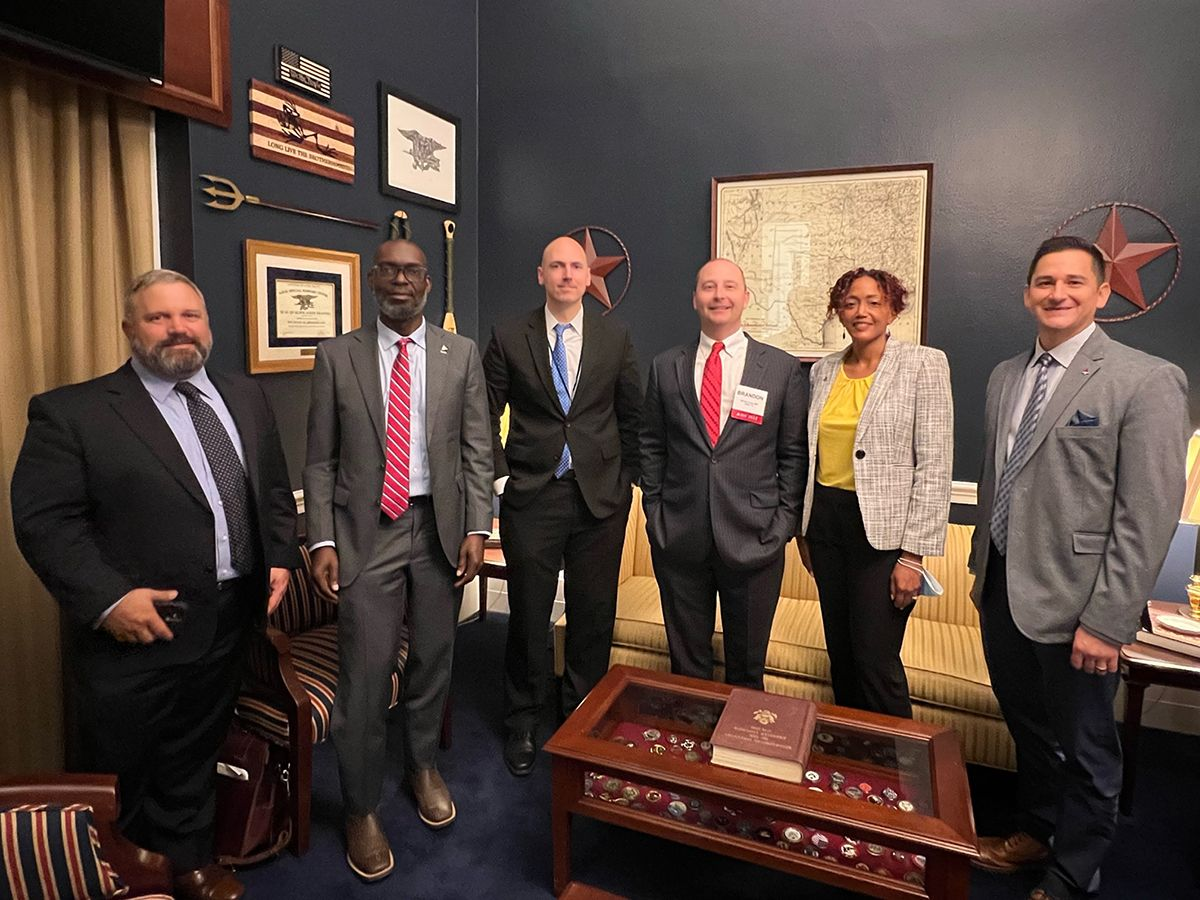
Last week, the Texas contingent of Appraisal Institute members — including our very own Mario Caro, MAI, AI-GRS, SR/WA — traveled to Washington, DC, for the annual meeting of the Institute’s Leadership Development Advisory Council (LDAC).
Among other activities, Mario visited the office of Representative Dan Crenshaw, who serves Texas’ 2nd District, to discuss the importance of H.R.5756, otherwise known as the Portal for Appraisal Licensing Act of 2021.
If enacted, this federal legislation would establish a single, centralized, web-based system that would allow both individual CRE valuation experts and CRE valuation firms to manage their licenses, certifications, and registrations, regardless of the state(s) in which they practice.
Thank you, Mario, for advocating for the appraisal profession!
No matter how you choose to measure success, commercial real estate (CRE) has more than rebounded from the initial shock delivered by the pandemic.
- According to the Mortgage Bankers Association (MBA), commercial real estate mortgage loan origination exceeded $890 billion in 2021. That record-setting total represents year-over-year (YOY) growth of 45 percent.
- For 17 straight months (June 2020 through March 2022), Real Capital Analytics (RCA) has reported increases across its Commercial Property Price Indices (CCPI). Moreover, the CCPI is up more than 17 percent so far in 2022.
- The Dodge Construction Network reports that in two of 2021’s top three markets — Dallas and Miami — new commercial and multifamily building starts were up by an average of 55 percent over 2020. And, through Q1 2022, nonresidential building starts are up 26 percent over Q1 2021.
These numbers are good news for brokers, investors, lenders, and landlords, but they may be even better news for appraisers. Demand for CRE valuation services has never been higher, and the need for new talent in the field will only increase over the next 3 to 5 years.
Although career opportunities abound for CRE appraisers, especially those whose geographic competency encompasses the Sunbelt, the profession is not necessarily well-understood, either outside or within our industry. That’s why we invited three LPA Team members to shed some light on what it’s actually like to research, inspect, and produce comprehensive reports about the market value of commercial properties.
Specifically, we’ve asked Brent Elliott (Senior Managing Director, Houston), Anthony Osburn (Director; Dallas), and Nicole Storm (Associate; Lubbock) to talk about the skills that have helped them thrive here at LPA.

1) Curiosity
According to Nicole, the first lesson of CRE appraisal is that “nothing is boring.” In fact, Nicole’s experience has been one of constantly expanding her comfort zone. “With any commercial property, there’s always more information to gather and analyze than appears on the surface,” she says. “I’ve tried to leverage that fact to grow in my role. My advice to anyone starting out in this field would be to take on every different property type or ‘unusual’ report that comes your way. That’s the best way to learn how to ask the right questions and delve into the complexities that come with certain properties.”
For Brent, staying curious has meant keeping his antennae up. Beyond staying current on broader economic trends, he says, “slowing down to listen” is also essential. “My job is to deliver highly informed opinions about commercial property values. When I listen to as many different stakeholders and consider as many different points of view as I can, I almost always discover additional information I otherwise wouldn’t have been aware of.”
2) Flexibility and Tenacity
Asked to describe his days and the tasks that come with it, Anthony says the keyword is “fluidity.” He adds: “You have to be able to pivot. The path to an appraisal report is anything but linear. With every appraisal, there are so many nuances to examine. Any one of those nuances can be deep, too. You really have to dig to get some data or to extract its optimal value.”
Nicole concurs. “Sometimes, in my preliminary research, I’ll find myself thinking, ‘How in the world will I find any data to support this?’ But I keep searching, combing through the fine details, and collaborating with the other experts in my office. Those reports take a lot of problem-solving, but the good feeling I get when I turn them in on time makes it all worth it.”
Finally, Brent emphasizes that open-mindedness is an underappreciated aspect of resilience. “Occasionally, I have to remind junior appraisers that, although you need to own the hard work that goes into the appraisal, there’s no reason to get your pride wrapped up in it. We are here to provide our professional opinion, so the more facts that you can gather, the better supported your conclusions will be.”
3) Outstanding Time-Management Skills
CRE appraisers live by many commandments, but two items in particular top any list of the profession’s best practices.
- Make your deadlines.
- Always keep your calendar up-to-date. As Brent notes, “We don’t spend all of our time sitting in front of a computer. We spend just as much time in the field, so we need to be smart about the travel choices we make.”
“Hitting due dates is huge in the appraisal profession,” Nicole affirms. “As a goal-oriented worker, I love having due dates and knowing what I need to do within a specific time frame.”
Anthony adds that “from the initial bidding process to sharing our professional opinion with the client, we have just a few weeks to complete our market research, perform property inspections, pull comps, and write and edit our reports. We can’t take any of those steps in the process lightly if we want to deliver our work on time — and our goal is to do that 100 percent of the time.”
4) Excellent Communication Skills
Appraising commercial properties is not just a matter of crunching numbers. It is, as Brent says, “very much a people business.” The most accomplished CRE valuation experts understand that they must expand their expertise into the realm of soft skills. “In this profession, you have to know how to talk to various industry stakeholders,” says Anthony. “You have to know their preferred communication channels and styles. The better communicator you are, the more opportunities you’ll find to advance in your career.”
Nicole agrees. In her experience, “you can be the smartest or most diligent person in the office, but if you can’t communicate with property contacts, brokers, lenders, or your own team, you’re going to find doing your job is much more difficult than it should be.”
Despite having met the profession’s gold standard by earning his MAI Designation from the Appraisal Institute, Brent admits that “communicating the support for my opinions in an effective manner has been the skill I continue to hone and work on every day.”
5) A Love of Learning and a Drive to Grow
For Anthony, Brent, and Nicole, every day they work in appraisal is an education. Based on their comments, they wouldn’t have it any other way.
“Teamwork is one of the Core Values everyone at LPA upholds,” Nicole points out. “And I’ve definitely benefitted from everyone working hard to stay hungry, humble, and smart. Knowing that there are people who expect more of you and are there to help you achieve your goals has provided great motivation for someone like me who’s just starting out in the industry.”
But what about more formal education? According to Anthony and Brent, having the desire and discipline to complete all the credit hours required to add acronyms like AI-GRS, MAI, and SRPA to your business card is only half of the equation. “Those efforts don’t mean much if you don’t work in a culture that values lifelong learning and continuous improvement,” Anthony explains. “With the help of LPA, I’ve been able to become a state-certified appraiser, and I’m currently working toward getting my MAI designation.”
Brent’s experience has been very similar. “During my nine years at LPA, I’ve been able to obtain my state certification and MAI. Now I’m working towards other appraisal designations,” he says. But he also reminds us that securing these designations is not an end in itself. “They give me additional tools to perform my job at a higher level. The better I do my job, the more marketable skills I develop, and the more value I create for our clients.”
Building a Career in CRE Valuation
The appraisal profession is full of opportunities for young professionals, provided they have matching interests and aptitudes. However, the best opportunities to be seized are in those work environments where ethics are not only preached but also practiced.
At LPA, we invest in a principle-driven culture and the people who bring it to life. We strongly support the development of all the traits CRE valuation professionals need to succeed. Powered by dynamic professionals like Anthony, Brent, and Nicole, we’ve experienced exponential growth in the 12 years since our founding. In the last four years alone, our organization has almost tripled in size, extending our service area beyond Dallas, Houston, and San Antonio by opening new offices in Corpus Christi, Fort Worth, Lubbock, and El Paso.